Seeing the forest for the trees

Welcome to Carbon Risk — helping investors navigate 'The Currency of Decarbonisation'! 🏭.
Thank you to all the lovely subscribers that have taken out a paid subscription. Your support is much appreciated. Carbon Risk contributes 1% of its revenue to Stripe Climate, helping to scale permanent carbon removal technologies.
If you enjoy this article please share it with someone, and check out the Table of Contents for more insights.
New Zealand goes to the polls on Saturday 7th November in an election that could have huge ramifications for the country's carbon market. Right now, with less than three weeks to go, its nip-and-tuck as to which of the main parties will come out on top.
New Zealand's incumbent National Party leader, Christopher Luxon is favourite to be the next Prime Minister (53% probability) according to Polymarket, versus 47% for opposition Labour Party leader, Chris Hipkins. However, as the chart below illustrates, the fancied winner has chopped-and-changed frequently since the election was called back at the start of the year.
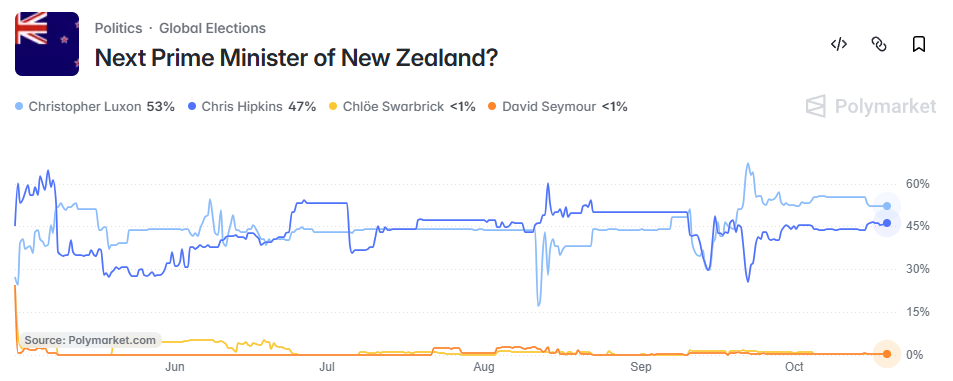
Crucially, due to the way general elections have been fought in New Zealand since 1996, the largest party isn't necessarily the one who governs. With parties struggling to secure an outright majority, coalitions have been the norm, and that makes projecting the likely mix of policies taken forward by the next government fraught with difficulty.
To be clear, the incumbent New Zealand government has overseen a dramatic pullback in climate policies, perhaps only surpassed by the Trump administration in the United States. Shortly after gaining power a long list of domestic climate programmes were scrapped or were told that their funding was being cut. The government has also distanced itself from international climate negotiations such as the carbon pricing mechanism under development for shipping.
It has since downgraded its biogenic methane target, curbed its climate disclosure regime, and moved forward with plans to build an LNG terminal, despite protestations that it will lock New Zealand into long-term fossil fuel dependence. Furthermore, in August it became the first country to enact legislation barring anyone from suing polluters for contributing to climate change (see Gas pains: A super-pollutant gets the cold shoulder).
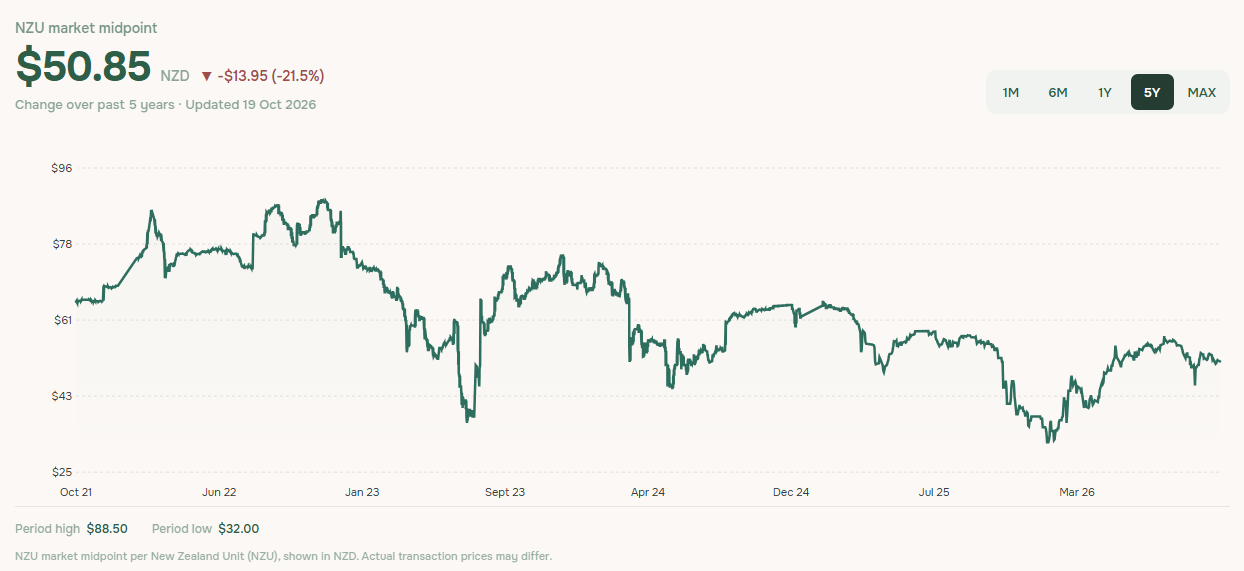
When the National Party came to power in October 2023 the price of an emission allowance (the New Zealand Unit, or NZU) was trading at NZ$68. Its been a case of sell the rip ever since. The price even dropping to as low as NZ$32 in January 2026, the weakest price seen since June 2020, as confidence in the governments commitment to the carbon market cracked. It rebounded to NZ$55 in the summer, but even that rally has fizzed out as the polls have narrowed and uncertainty over the NZ ETS' future has grown (see New Zealand's carbon price slumps as confidence cracks: Government announces it will break link with net zero target).