Europe's demand destruction threshold
On why this (probably) isn't 2022 again, why coal can't stage a comeback and funds are not chasing EUAs higher, and finally, a UK-EU reunion moves closer


Welcome to Carbon Risk — helping investors navigate 'The Currency of Decarbonisation'! 🏭.
Thank you to all the lovely subscribers that taken out a paid subscription to Carbon Risk. Your support is much appreciated.
If you enjoy this article please share it with someone, and check out the Table of Contents for more insights.
Eurozone manufacturing activity surged to a 55-month high in September according to purchasing managers survey data from S&P. Pro-European media outlet Rapporteur (formerly Euractiv) ran with the headline, "‘Too good to be true’: Eurozone economy defies Iran war shock". Well, yes quite possibly if energy prices continue to rise. But where is the pain point, the demand destruction threshold where things start to unravel?
The European natural gas price (TTF) is down from its mid-September peak but it is still trading around the €75-80 per MWh range. Middle East oil flows may have returned to around 90% of pre-war levels, but this hasn't helped Europe with a mere 25% of the normal LNG cargoes departing the Strait of Hormuz. The risk of further price rises remains if the conflict in the Middle East reignites and energy flows are throttled once again. Meanwhile, Europe once again goes into winter light on gas storage.
Fears that demand destruction would stage a return began to intensify last month, and they haven't gone away just because the upward trajectory in energy prices has ameliorated. The most notable news came from INEOS, the chemical giant announcing that output at several of its European plants would either be paused or they would be shutdown permanently. The company citing high energy and carbon costs, and a lack of tariff protection.
European energy prices would need to rise by a further 20-30% before they reach levels historically associated with significant demand destruction, according to analysis presented by ICIS in a recent webinar. The key threshold that natural gas consumption starts to respond is when TTF is around €75-90 per MWh. For electricity, demand begins to taper significantly when power prices reach the €175-195 per MWh level (French and Belgian power prices are around €100-140 per MWh).
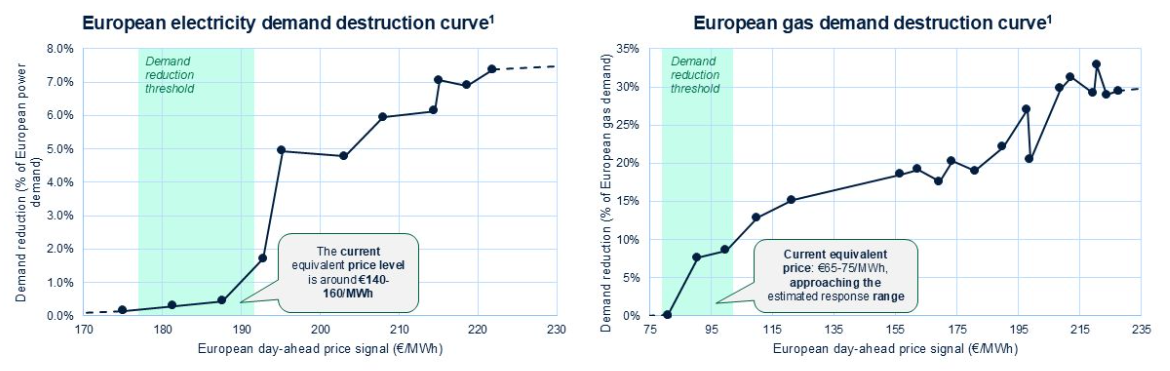
Crucially, as ICIS analysts point out, the 2026 energy crisis is very different to the 2022 crisis.
First, the epicentre of the 2022 crisis was Europe. The Russian invasion of Ukraine and the subsequent cuts to Russian natural gas exports shook Europe's economy to the core. Although the impact did reverberate around the world, it was essentially a European energy crisis. Fast forward to 2026 and the US/Israeli conflict with Iran has from the very start been a global energy shock.
Second, expectations matter as to whether and how households and companies respond. It didn't take long for people to appreciate that the 2022 Russian invasion of Ukraine would precipitate a seismic and structural shift in Europe. In short, expectation over the length and severity of the crisis quickly became embedded in decision making. In contrast, the conflict in the Middle East has (up until now at least) been perceived as much more short-term in nature.
Third, this isn't Europe's first rodeo. Its economy has adapted, with industry becoming more energy efficient and employing more sophisticated and precautionary hedging strategies. Meanwhile, the surge in European energy prices observed this year has - so far at least - been much more restrained than 2022, giving more time to react.
The upshot of this is that European companies response this time appears to be different. The perception that this is a short-term, global energy shock means there is little incentive to close energy intensive production facilities in Europe and start afresh somewhere else in the world. Allied to Europe's greater preparedness suggests that demand destruction (once again, at least based on events so far, I hasten to caveat) is much less likely to occur.
There is another big caveat to this. Unlike 2022, diesel has now joined the cast of villains casting a long shadow over Europe's economy. Surging diesel prices feed directly into higher freight and manufacturing costs, acting as a brake on economic growth while also driving up prices for consumers. European industry is better prepared for a power and gas crisis, but it would not have foreseen a diesel crisis.
Coal back in the money, but switching capacity is limited
Despite the recent increase in the price of natural gas in Europe, there has been little sign of an uptick in coal generation (and its associated emissions). The Centre for Research on Energy and Clean Air (CREA) publishes real time data showing the 30-day running average for European power generation and emissions by source. Emissions from coal plants are only slightly up on 2025 levels but well below that seen during 2016-22.
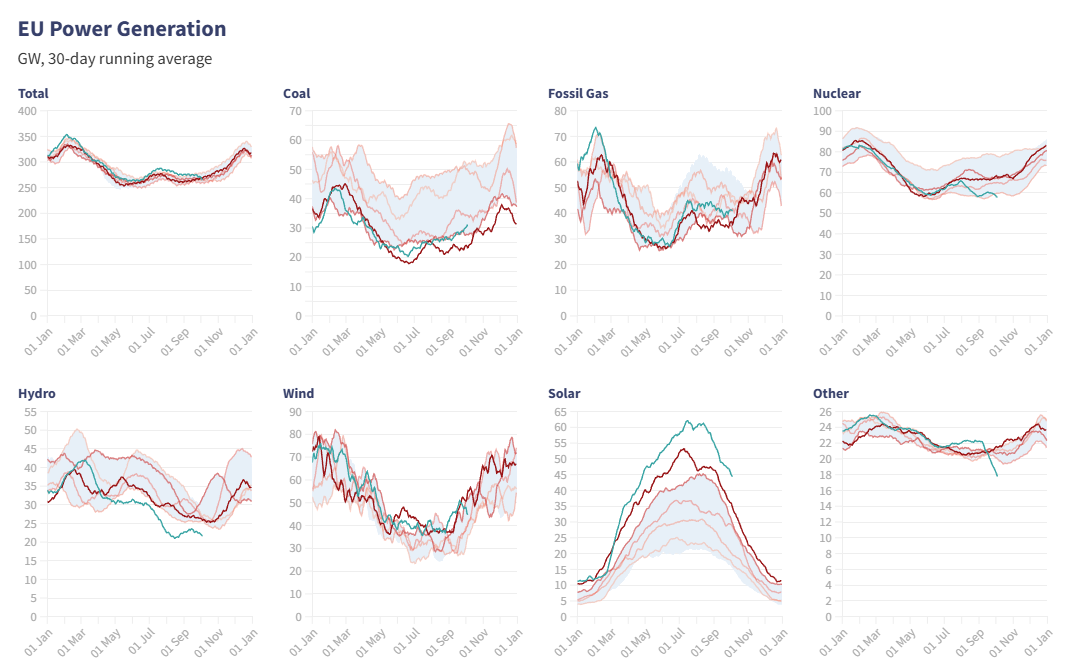
The situation is expected to get worse. For the first time since at least 2024, coal and lignite plants are now more profitable to run than gas-fired equivalents. The chart showing thermal coal generation does show a notable pickup in late September and into October. Nevertheless, given the ongoing retirement of coal assets across the EU, there is very little switching capacity left, so we shouldn't expect a significant spike in coal generation emissions, even if natural gas prices remain high into the winter.
Funds show little appetite to chase the market
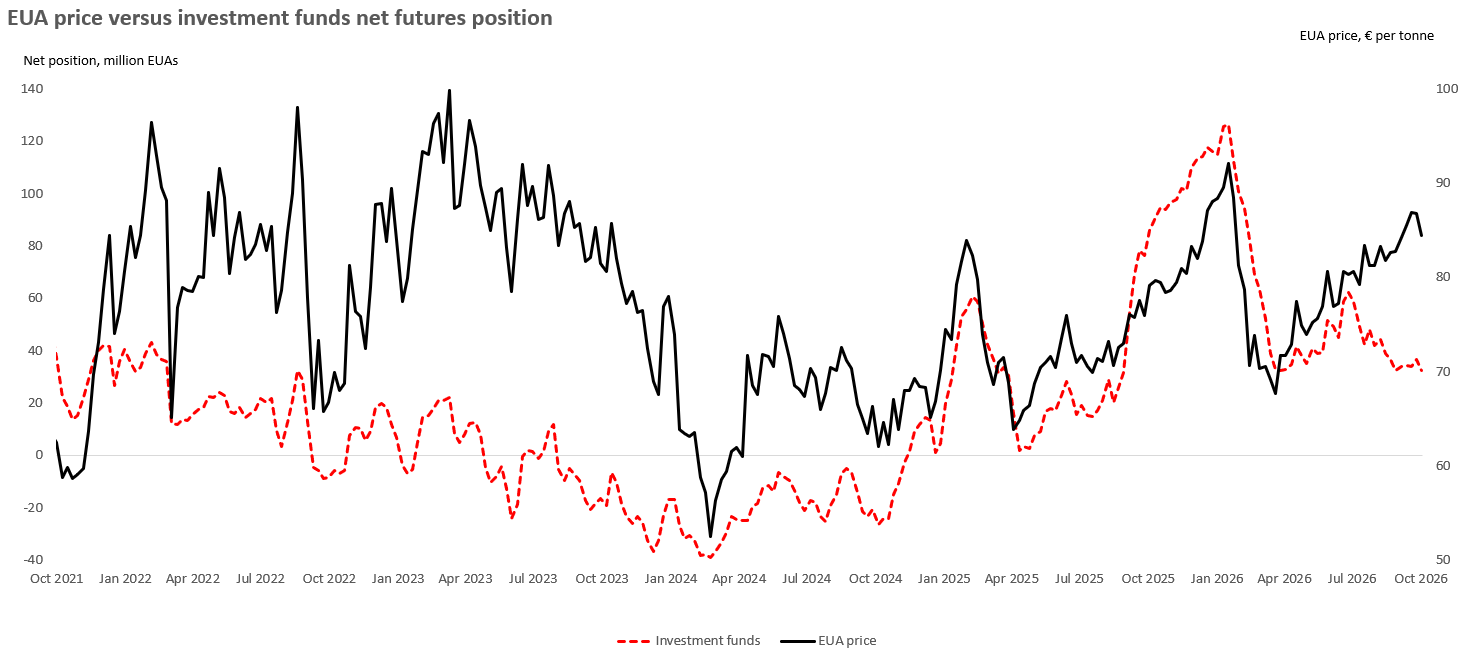
The latest Commitment of Traders (COT) report for w/e 2nd October shows that investment funds now sit on a net long position of 32 million EUAs, down from 62 million EUAs in mid-June. Intriguingly, the pullback in the net position has coincided with a €10 increase in the carbon price. It's unusual and perhaps the first significant divergence we've seen since 2022.
One possible explanation is that funds are mindful that recent high energy prices could act as a brake on economic activity, or spark renewed policy uncertainty. On the latter, this could manifest in calls for a softening in reforms, or that the process could get bogged down in delays, opening up far greater political risk if it starts to get close to the French elections.
Another explanation is that funds have determined that compliance demand was the main reason for the increase, and that it will inevitably soften after the end of September deadline. The assumption here is that uncertainty over the future of the EU ETS in the spring may have led some companies to delay their compliance procurement.
Finally, we shouldn't forget the recent spike in long term interest rates. Funds may be reluctant to build a larger long position given the increase in spreads at the back end of the curve. Even more so with the EUA price near €85 and the risk-reward ratio tilted to the downside as a surplus comes into view going into 2027 and 2028.
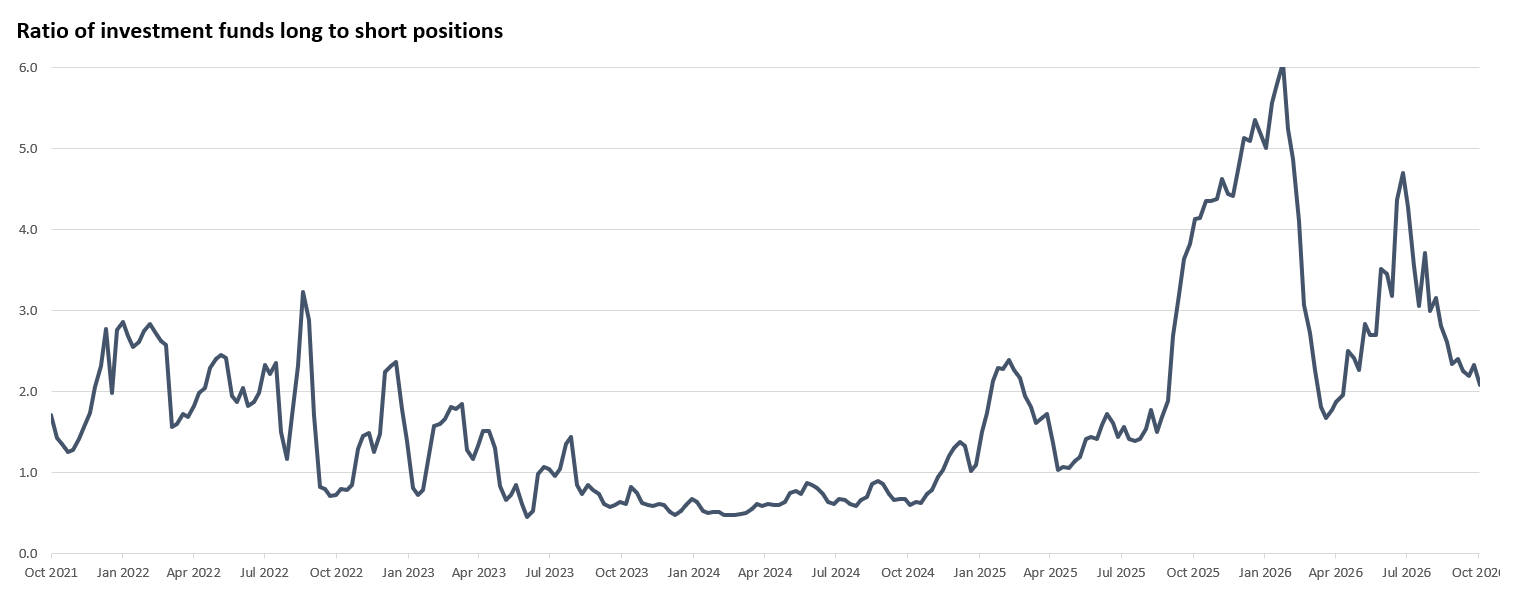
To close out this section, lets take a quick look at the long/short ratio. From a high of 6.0 in w/e 23rd January the ratio dropped to a low of 1.67 in mid-March, before rebounding to 4.7 in late June. It has since retreated all the way back to 2.0, close to the average observed since October 2021, and effectively brings it back to a neutral position.
European friends reunited
The last time I discussed the prospects for a linkage between the UK and EU emissions trading schemes was in late June, shortly after Prime Minister Kier Starmer resigned (remember him?), to be replaced a couple weeks later by Andy Burnham (see Britain's green credibility gap).
The immediate concern for the markets was the timing of the EU-UK summit, from whence everyone expected a linkage agreement to be signed. Following Starmer's resignation Antonio Costa, the President of the European Council, announced that the event will be postponed - date TBC.
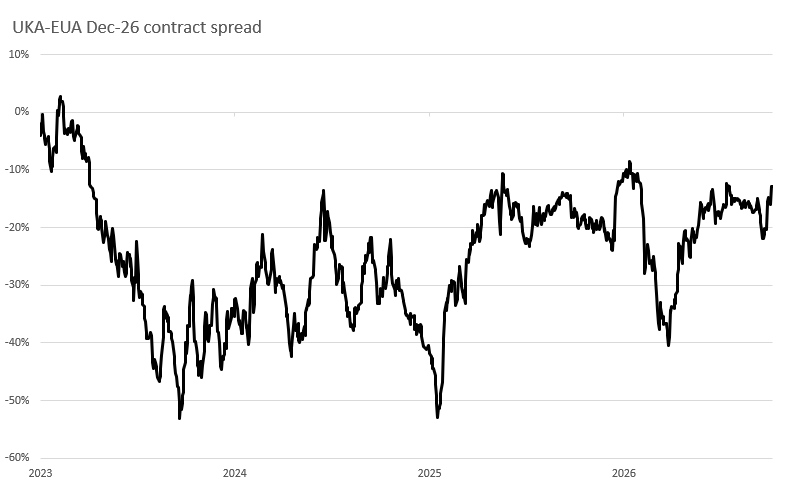
Investment funds have taken it in their stride, pricing in a consistent discount of around €10-15 (~15%) over the past few months. As I noted back in my earlier article, even after the signing of a linkage agreement there is still likely to be a discount of about 10%. The only time the spread widened was in late September when last minute compliance demand may have caused a brief spike in the EUA price.
Also coming at the end of the month, Prime Minister Burnham confirmed that the summit would happen in the coming weeks, with 20th November thought to be the most likely date. In another pro-European move - not surprising if you read Carbon Risk - Burnham has since openly talked about going "all the way" and re-joining the EU.
Although positive from the prospects of UK-EU linkage discussions, the move threatens to open up a old wounds ahead of the next general election (due by to take place by 2029). It is likely to be used by opposition parties such as Reform (very much anti-climate policies) to tilt public opinion to their advantage.
Finally, the prospect of greater integration between the UK and the EU - beginning with their respective carbon markets - means that macroeconomic or political shocks in Europe will be transmitted 1-1 to the UK ETS. If the outlook for EU ETS reforms worsens that will also dim the prospects for the UK carbon price too, and vice versa.
 Peter Sainsbury