Repost: Climate change is showing its claws - it's time to adapt


Welcome to Carbon Risk — helping investors navigate 'The Currency of Decarbonisation'! 🏭.
Thank you to all the lovely subscribers that have taken out a paid subscription to Carbon Risk. Your support is much appreciated.
If you enjoy this article please share it with someone, and check out the Table of Contents for more insights.
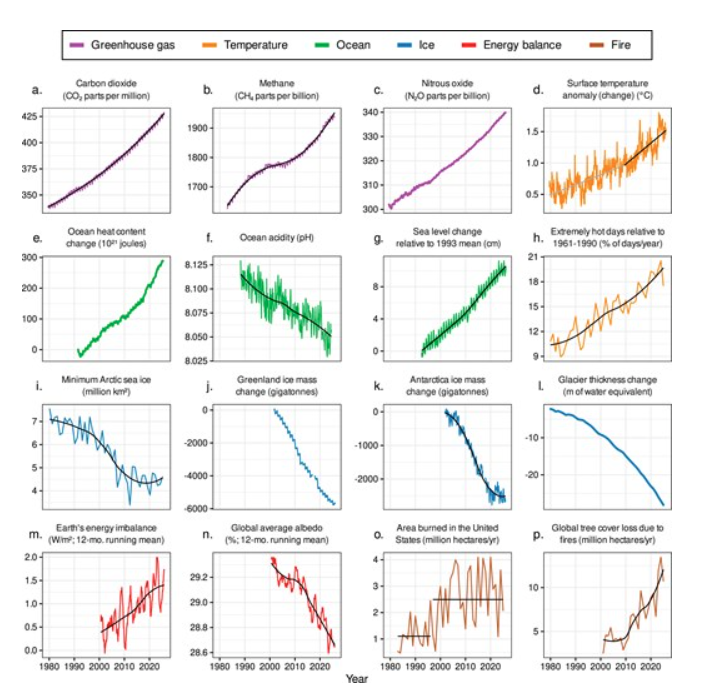
Don't look up! The 2026 State of the Climate Report has just been published. The report monitors 16 planetary vital signs and shows that the Earth’s climate system is moving deeper into uncharted territory. To mark the occasion I'm reposting an article from last October (now with the paywall removed) on the returns from investing in climate adaptation alongside mitigation.
“Adaptation, by building resilience to climate impacts, avoids damaging decreases in income." - Nicholas Stern
The Earth has reached its first catastrophic tipping point linked to rising GHG emissions.
The Global Tipping Points report, led by the University of Exeter warns that warm water coral reefs now face long-term decline, risking the livelihoods of hundreds of millions of people. The reports authors caution that unless we return to global mean surface temperatures of 1.2°C (+2.16°F) the reefs will not be retained on any meaningful scale.
While the loss of warm water reefs and the knock-on impact on fishing, tourism, and coastal protection paints a disturbing picture, it's difficult to ascertain what it means versus the economic incentive to mitigate climate change. It's why the net economic damage resulting from an incremental tonne of carbon dioxide (CO2) released into the atmosphere is often boiled down to one figure - the social cost of carbon (SCC).
Previous SCC estimates, such as that produced by the economist William Nordhaus, focused on country-level local temperature variations and typically found that a 1°C temperature shock reduces global GDP by at most 1-3% in the medium term. In 2017 Nordhaus estimated that the SCC in 2010 was $31 per tonne, or almost $50 now once you factor in inflation, while suggesting that the optimal level of global warming was just over 4°C.
A paper published last summer by economists at Harvard and Northwestern University focused instead on global temperature shocks predicting a larger and more persistent rise in the frequency of extreme climatic events. Employing long-term data on global economic growth and average annual temperatures, the researchers estimate the SCC to be more than 20-times larger, at more than $1,000 per tonne of CO2, with each additional 1°C of warming likely to lead to a 12% fall in global GDP.
Were it not for the Earth already having experienced 50 years of warming, the researchers contend, our society would been 37% better off than it is today. Past performance doesn't necessarily equal future performance of course. As the planet warms the likelihood that further tipping points are breached rises, increasing the probability of a non-linear relationship developing between temperature changes, climatic conditions, and the resulting impact on economic activity. In other words, the tail risks keep getting fatter.
But what to do? One side of the economic cost of climate change coin is the need to invest in climate mitigation; renewables, electrification, decarbonising heavy industry, etc. The other side of the coin is adaptation and resilience; enabling our societies to weather the impact of more extreme climatic events (both that experienced in the present and projected to occur in the future), ameliorating the potential hit to economic activity.
The two sides don't necessarily have to be mutually exclusive. A richer, more advanced global economy means more resources can be directed at mitigation as well as adaptation. Focusing just on the former, and neglecting the latter, risks leaving a world unable to do either, with the poorest parts of the world most exposed. And besides, as we'll see, the returns on investment in adaptation can be significant and on a much shorter timescale than mitigation.
As the world has naturally focused on climate mitigation, surprisingly little attention has been paid to climate adaptation and resilience. More than 90% of global climate finance to date has been spent on slowing or stopping climate change, according to JP Morgan. In contrast, less than $65 billion per year has been invested in climate adaptation, primarily from development funds and public institutions, and at levels only one-sixth of that expected to be required by the end of the decade.
As the toll of past financial impacts from climate change become more quantifiable, the easier it is to project exposure forward to understand potential future climate impacts. S&P have built such a model for the S&P Global 1200 (companies representing ~70% of global equity market capitalisation), projecting future losses to physical assets if no climate adaptation measures are implemented. They assume that GHG emissions stabilise at current levels until 2050 before declining, while global average temperatures rise by 2.7°C by the end of the century.
S&P estimate that by the 2030's large companies are expected to face annual physical climate related losses of almost $0.9 trillion without adaptation measures, rising to $1.2 trillion by the 2050's. To put that in context global natural disasters caused $320 billion of losses in 2024, according to Munich RE, almost 80% higher than the 30-year inflation-adjusted annual average ($181 billion). Almost 80% of the physical risk costs relate to the impact of extreme heat and water stress.
Utilities, financials and energy are the most exposed sectors of the economy, accounting for $0.6 trillion or 50% of the potential losses. Companies are beginning to look up and take notice. Analysis of investor communications by utilities reveals that mentions of terms related to climate adaptation and resilience have steadily increased, particularly so since 2017, and then again in 2021. In contrast, words related to mitigation have plummeted since 2021, mirroring the broader decline in corporate interest (publicly at least) in sustainability.
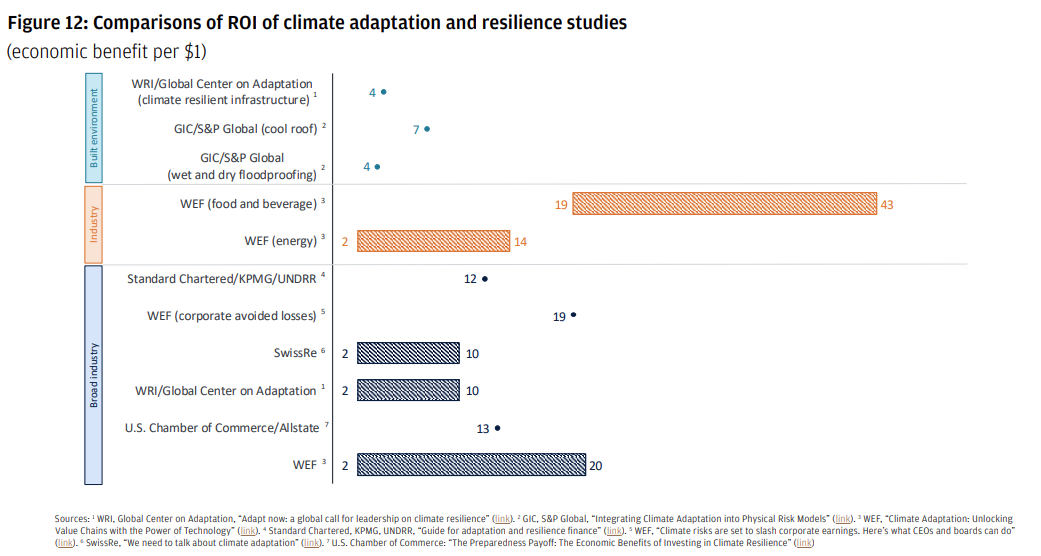
Although the narrative presents climate adaptation as a risk to be managed, study after study has found that adaptation offers a significant return on investment. It's not simply about avoided losses, but also induced economic development, and additional social and environmental benefits. For example, a study by the World Resources Institute (WRI) found that every $1 invested in climate adaptation yielded more than $10 in benefits over a 10-year period. The WRI analysed 320 adaptation investments (totalling $133 billion), spanning agriculture, water, health and infrastructure, located across 12 countries over the period 2014 to 2024.
If organisations follow through on their talks with investors and begin to devote hard cash for climate adaptation then demand for the most promising climate adaptation technologies could reach $1 trillion by 2030, according to McKinsey. Solutions focused on buildings (e.g. AC, heat pumps, insulation) are expected to account for almost half of the expected market demand. Elsewhere, technologies that help society reduce the impact of heat stress and water scarcity on the broader economy are likely to be in demand: smart grids, advanced irrigation, and desalination are just some of the examples.
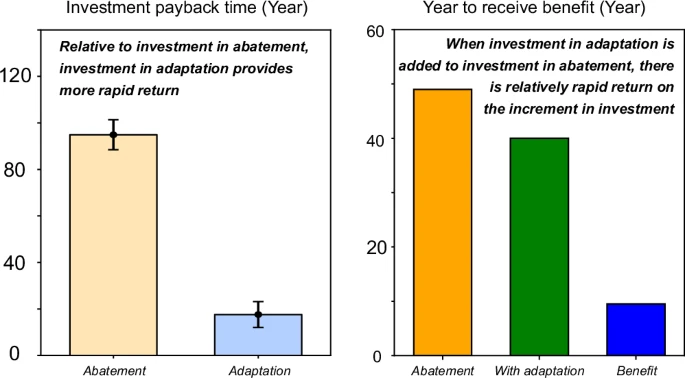
But what combination of mitigation and adaptation works best? A recent paper published in Nature shows that adaptation deployed in conjunction with mitigation (or abatement, as they call it) allows earlier (12-26%) and larger net benefits (14%) compared to investment in abatement alone. High levels of mitigation investment associated with stringent emissions reduction constraints can reduce returns on adaptation. However, when adaptation is used in conjunction with mitigation, both strategies help avoid climate damage while increasing consumption, both for people who are alive today and for future generations.
For example, the Global Commission on Adaptation published a study in 2019 highlighting five key adaptation investments with strong returns on investment: early warning systems, resilient infrastructure, productive dryland agriculture, mangrove protection, and resilient water resources management. Protecting marine ecosystems such as mangroves offers a win-win for both climate mitigation and adaptation.
These blue carbon assets are among Earth’s most efficient absorbers and long-term repositories of carbon; mangrove forests can store more than 1,000 tonnes of carbon per hectare, more than four times the amount sequestered by terrestrial forests. Meanwhile, mangrove forests protect coastlines from storm surges, helping to reduce damage from extreme weather events such as cyclones (see Banking on 'blue carbon': Everything you need to know about carbon credits sourced from the ocean).
As I note earlier, a richer world should be better prepared to invest in both mitigation and adaptation. One of the most important factors is expectations. If governments, companies, and individuals begin to expect a more volatile climate then they will adjust - perhaps employing some of the technologies mentioned earlier. An increase in climate resiliency should result in a net increase in GDP as severe weather is less able to inflict losses.
To test this hypothesis, researchers at Columbia University looked to the past, collecting data from more than 100 countries where extreme weather events occurred between 1980 and 2019, and then estimating how much the damage from cyclones and heatwaves has declined due to changing expectations about future occurrences.
The study estimates that GDP per capita growth has increased by some 0.2% per year (or 7% in total) as people adapted to cyclones. The effect of heatwaves was about half that, with a cumulative increase in GDP per capita of 4% over the same period. However, as climate change intensifies and results in more extreme and frequent weather events the GDP gains associated with adaptation are likely to be even larger.
At anyone time we only have a limited amount of resources to tackle society's problems: tackling climate change, improving the environment, ensuring energy service abundance for all, and everything else that matters. While some suggest that all resources should be devoted to climate mitigation, and even a small amount spent on adaptation is wasteful, it's clear that it doesn't have to be either or. In fact, this article demonstrates that it works best if both issues are tackled side by side - mitigate, but also adapt.
 Peter Sainsbury