US 'energy dominance' will depend upon CO2
Billions of barrels of oil could be unlocked, but only if thousands of miles of CO2 pipeline are laid
“…CO2 is going to be much needed for the US for our extended energy independence.”
- Vicki Hollub, CEO of Occidental Petroleum
Enhanced oil recovery (EOR) involves injecting high-pressure CO2, sometimes alternated with pulses of water, into an oil reservoir, scrubbing the existing pathways within the rock, enabling a more efficient flow of oil. By pushing more crude to the surface, EOR can recover up to 60% of the oil remaining in a reservoir.
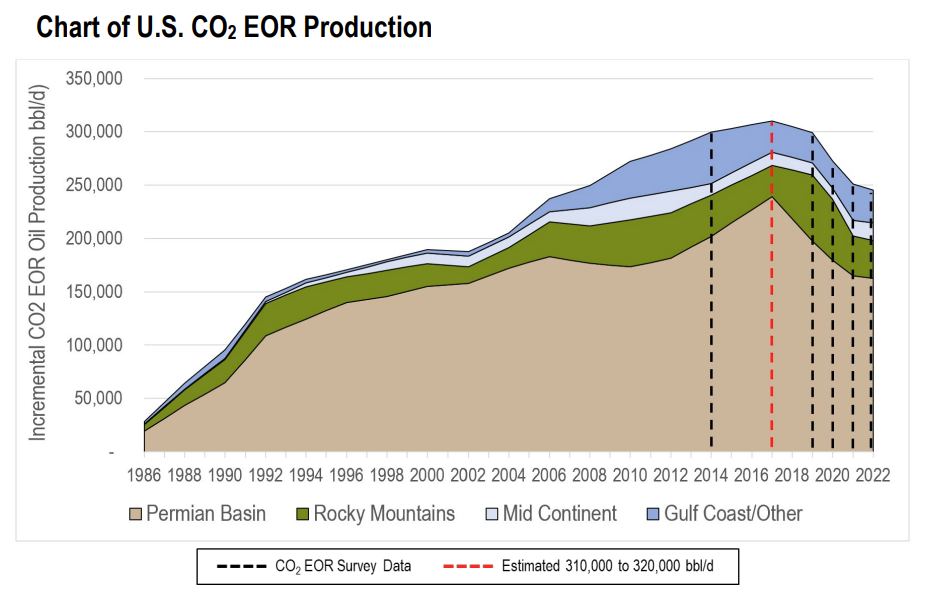
Incremental oil recovery from EOR was estimated to be around 250,000 barrels per day in 2022/23, according to the U.S. CO2 EOR Survey. This is the additional amount of oil extracted from oil reservoirs using EOR techniques, beyond what could be recovered through primary and secondary recovery methods.
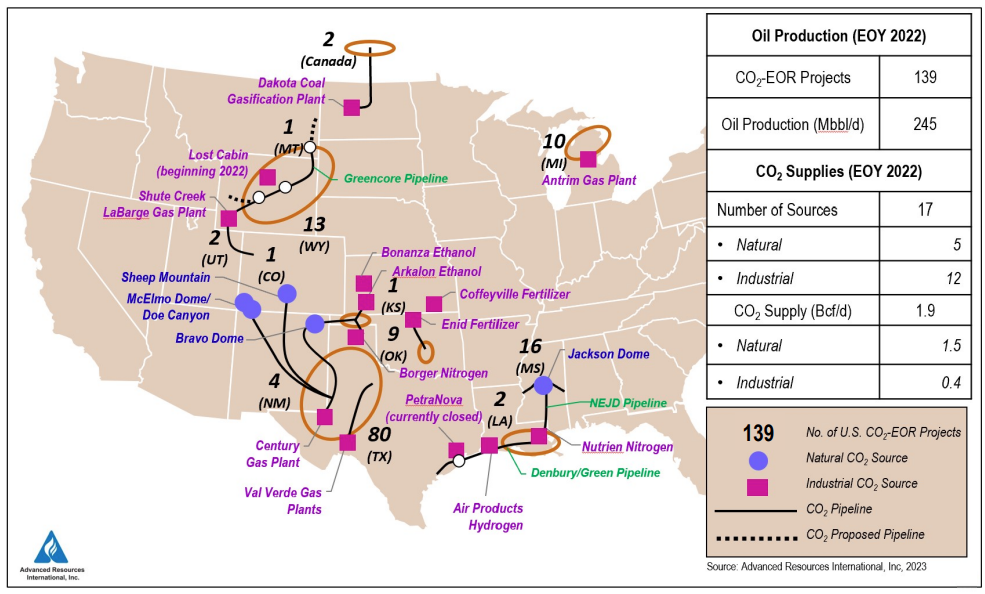
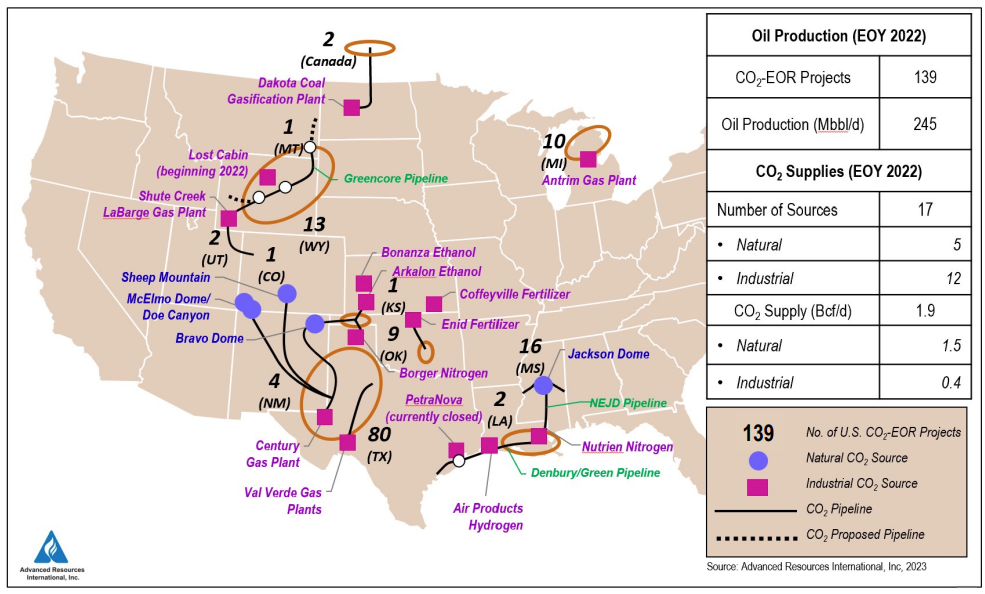
About 35 Mt of CO2 is currently used for EOR in the US, with more than three-quarters sourced from natural underground CO2 deposits located nearby, with the remainder derived from industrial emitters such as ethanol plants. Overall, this works out at an average utilisation rate of 0.4 tonnes of CO2 per barrel of oil extracted.1 2
US EOR oil production has dropped by about 20% since it peaked in 2017 at just over 300,000 barrels per day. The main factors behind the decline were the drop in the price of oil, a shortage of industrial sourced CO2, and a move towards maximising the use of horizontal drilling by oil producers.
EOR lowers the carbon intensity of US crude production
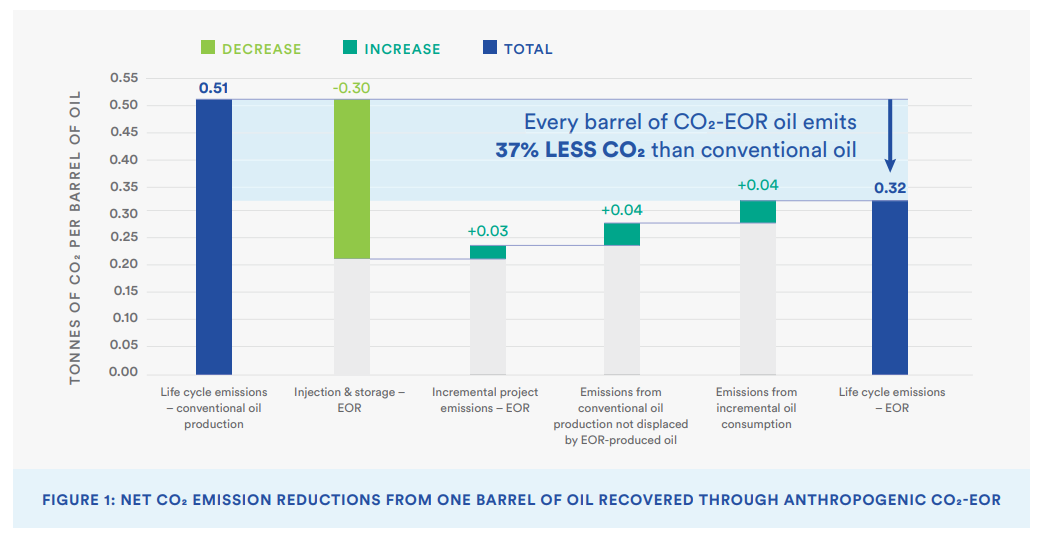
Analysis by the Clean Air Task Force, drawing on lifecycle analysis (LCA) by the International Energy Agency (IEA) compared the “well-to-wheel” emissions of EOR produced oil versus conventional oil and found that EOR results in a significant reduction in emissions per barrel.3
To start, the CATF estimates that one barrel of conventional oil emits 0.51 tonne of CO2 per barrel. EOR involves injecting CO2 helps to release crude oil trapped in the pores of the source rock, in the process permanently trapping the CO2. Recovery of every barrel of oil produced through EOR typically involves injecting and utilising 0.3-0.4 tonnes of CO2 per barrel. Hence, relative to conventional oil production, EOR lowers the well-to-wheel emissions to 0.21 tonnes of CO2 per barrel.
However, EOR operations have higher process emissions compared to conventional oil. The separation and recycling of CO2 involves an additional 0.03 tonnes of CO2 emissions per barrel of oil produced. The CATF estimates that EOR produced oil displaces around 84% of the emissions from conventional oil production, leaving emissions higher by 0.04 tonnes of CO2 per barrel. Finally, the increase in oil production due to EOR - and the associated drop in the price of oil - results in an increase in consumption, and a corresponding rise in emissions (0.04 tonnes of CO2 per barrel).
Overall, the CATF estimates that EOR results in a 37% reduction in emissions per barrel, compared to conventional oil production. Another study, this time employing a dynamic LCA, measured the net CO2 released over time. It found that EOR oil projects are typically net carbon-negative at first (up to anywhere between 6 and 18 years depending on the processes used), but then as oil production declines, the EOR project moves towards becoming net carbon-positive. 45
During the course of EOR some CO2 does come back to the surface, but given the expense, operators typically recycle it and then reinject it underground. Oil producers need to balance the cost of paying to separate the CO2 from the production stream and inject it back into the oil reservoir, versus sourcing CO2 from natural or industrial sources, switching from one source to another when a certain price is reached. For example, the cost of sourcing CO2 from industrial sources is estimated to be in the range of $20-$45 per tonne.
Over the lifetime of a project around 90-95% of the CO2 injected into the ground is permanently trapped in the geological formation. However, about three-quarters of the CO2 sequestered underground is from naturally occurring CO2, casting doubt on the low-carbon intensity of EOR produced oil. One way that oil producers can alleviate these concerns is by ramping up the proportion of CO2 that they use captured from industrial sources, or by using CO2 removed directly from the atmosphere using direct air capture (DAC).
Industrial carbon capture could unlock billions of barrels
The potential for EOR to unlock billions of barrels of oil is immense. In 2020, the US Geological Survey (USGS) estimated that 29 billion barrels of oil might be produced using EOR technologies in amenable US conventional oil reservoirs. The USGS estimated that 8.4 Gt CO2 could be stored (retained) in the assessed oil reservoirs following the application of EOR.
The CEO of Occidental Petroleum indicated that EOR could potentially add more than double the amount of crude, “We believe the next round of technology that's going to add significant barrels, 50 billion to 70 billion barrels of reserves, will be production that comes from the use of CO2 in enhanced oil recovery.” If Occidentals forecast of the potential crude still to be accessed using EOR turns out to be correct then the ultimate CO2 storage potential could double to more than 16 Gt CO2.6
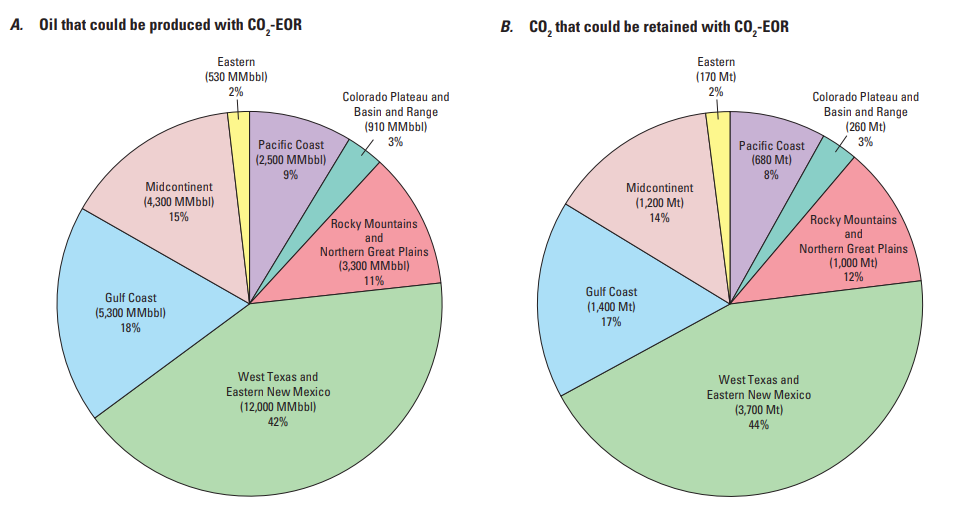
Other analysts point to even higher estimates of potential oil reserves (and CO2 sequestration) from EOR, perhaps in the hundreds of billions of barrels. For example, the US Department of Energy estimates that CO2 EOR could be used to extract between 84 and 181 billion barrels of crude oil in the US, with an estimated 177 billion barrels technically recoverable using existing technology - equivalent to almost 40 years of current US crude oil production.
If the US is going to begin accessing those additional billions of barrels of oil then it will need a lot more CO2. Remember that the majority of the CO2 used for EOR is taken from naturally occurring deposits located nearby. But as Occidental CEO Vicki Hollub outlined recently, “There’s not enough organic CO2 in the country to be able to flood all the things that we’re going to need to flood to get that 50 to 70 billion barrels.”
Occidental state that DAC will be vital to securing sufficient volumes of CO2. It’s $1.3 billion 0.5 Mt CO2 per annum Stratos DAC facility is expected to open this summer. The development of DAC capacity in Texas has been incentivised by the 45Q carbon sequestration tax credit, and with the backing of major corporations such as Amazon and Microsoft. The latter recently signed a deal with Occidental to purchase 500,000 tonnes of DAC carbon removal credits. Aside from the very high cost involved with DAC (>$500 per tonne of CO2), the deal stipulates that the CO2 must not be used for oil production.
It means that industrial carbon capture will need to play a much bigger role. US carbon capture & storage (CCS) capacity is projected to increase four-fold by 2030 to almost 100 Mt CO2 per year, according to a recent report from ING. Previous studies by Rhodium Group and Princeton University, published shortly after the Inflation Reduction Act (IRA) was announced in August 2022, were more aggressive in their forecasts. Their studies projected that CCS capacity could multiply as much 8-fold by 2030, and go onto reach 300-450 Mt CO2 by 2035 (see Carbon capture and storage (CCS) is misunderstood).7
Thousands of miles of CO2 pipelines are required
However, even with significant CCS and DAC capacity, the problem is transporting the CO2 to where it can be used for EOR. The US has the worlds largest CO2 pipeline system, stretching 5,200 miles and transporting 66 Mt CO2 each year. The CO2 pipeline network is primarily located in the Permian Basin with the majority of the CO2 being used for enhanced oil recovery (EOR). However, analysis by Princeton University (based on its CCS capacity projections) suggests that serving this burgeoning demand for CO2 will require 41,000 km of CO2 pipelines by 2035, transporting 246 Mt of CO2 per year.
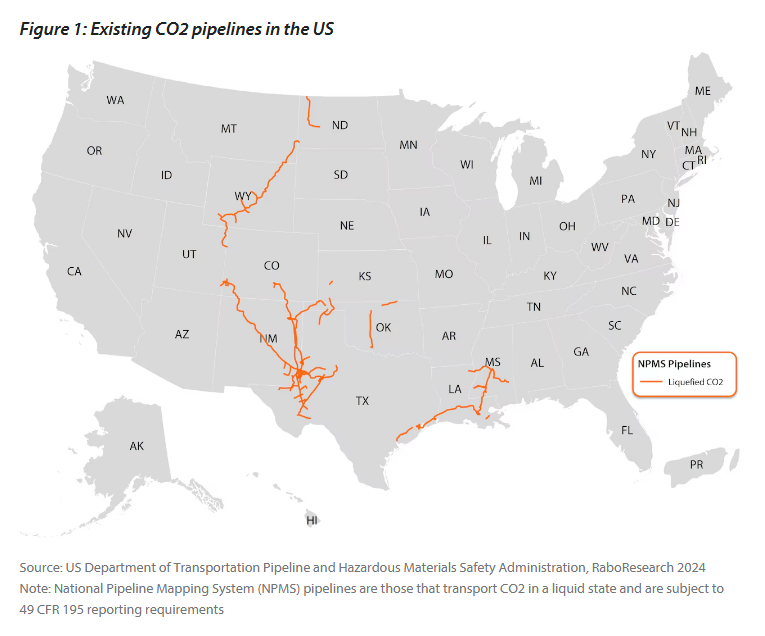
Up until recently four long-haul CO2 pipelines were under development in the Midwest to expand the existing CO2 pipeline network: three green-field developments (Summit Carbon Solutions, Navigator CO2, and Wolf Carbon Solutions), and one project that required repurposing of an existing natural gas pipeline (Trailblazer Pipeline).
In October 2023 an outcry over the environmental and safety risks involved with the green-field developments resulted in their CO2 permitting applications being rejected. Navigator announced that it would cancel its pipeline plans, Summit decided to postpone its projects until 2026, while Wolf Carbon Solutions initially withdrew its application only to then cancel the project completely at the end of 2024. As I outlined in Not in my backyard, the negotiations exposed an erratic regulatory position between states:
According to the Sabin Center for Climate Change Law, few of the federal legal frameworks governing pipeline infrastructure were designed with CO2 pipelines in mind. Moreover, with individual states having authority over the regulation of pipeline siting, development, and operation, putting together a network of CO2 pipelines across state borders is fraught with difficulty.”
Summit Carbon Solutions currently plans to source CO2 captured from 57 ethanol plants located across the Midwest and transported it via pipeline to North Dakota where it will be stored permanently underground. The 2,000 mile pipeline will be the worlds largest of its kind, and is estimated to be able to transport 13.5 Mt of CO2 per year.
Incentives may need to pivot towards rewarding EOR
However, fossil fuel producers are concerned that by permanently sequestering the CO2, they will miss getting access to a valuable resource that they could use for EOR. , Summit Carbon Solutions proposal relies on the 45Q tax credit of €85 per tonne of CO2 stored in saline geological formations, $25 more than that paid for every tonne of CO2 captured from power generation or industrial facilities and used for EOR.
Pressure to use the CO2 for EOR, rather than sending it directly for permanent storage, is coming also from state concern about finances. The Energy and Environmental Research Center (EERC) estimates that EOR could enable producers to extract between 5 and 8 billion barrels of additional oil from the Bakken Formation over the next 30-50 years. North Dakota’s tax commissioner estimates that EOR could generate $3-$9 billion over a ten year period for the states coffers, assuming it started in 2028.8
It’s not just at the state level where there’s pressure for change. The heads of three powerful US agencies - the Department of Energy, the Environmental Protection Agency, and the Department of the Interior - all gave a “resounding yes” in their nomination hearings when questioned whether they would work to advance CCS technology, address permitting delays, and utilise CO2 as a resource for additional oil recovery.
Chris Wright, the head of the DoE, affirmed his commitment to CCS to address CO2 emissions but also to support enhanced oil recovery (EOR). Lee Zerdin, head of the EPA confirmed that he would ensure the agency was a resource, rather than a barrier to CCS development. Finally, Interior Secretary Doug Burgum, a major supporter of CO2 pipelines as Governor of North Nebraska, agreed that CCS could help eliminate emissions. Burgum has also been picked by Donald Trump to chair the new National Energy Council, tasked with achieving American energy dominance.
If the US is to achieve energy dominance then it will need to secure more CO2 from industrial emitters.
The first task for the government must be to introduce federal regulations covering cross-border CO2 pipelines so that it can be safely transported across the country, from regions of concentrated industrial emissions to where the CO2 can be used for EOR.9
It must then look to increase the incentive for EOR under the 45Q tax credit. This will enable EOR oil producers the ability to secure CO2 from hard-to-abate industries, in turn incentivising investment in carbon capture.
Leveraging the desire to increase oil production, the ultimate prize for the United States is that it sparks a demand-led surge in industrial carbon capture investment, and repositions itself as a leader in the supply of low carbon intensity crude oil.
👋 If you have your own newsletter on Substack and enjoy my writing, please consider recommending Carbon Risk to help grow this amazing community of readers! Thank You!👍
https://www.oxy.com/siteassets/documents/investors/quarterly-earnings/oxy4q24transcript.pdf ↩
https://co2conference.net/wp-content/uploads/2021/01/2019-CO2-EOR-Survey-4-2-21-Final.pdf ↩
The 2020 survey revealed a slight fall to 273,000 barrels per day. Activity and survey responses will have been affected by the pandemic and associated lock-downs https://adv-res.com/pdf/ARI-2021-EOY-2020-CO2-EOR-Survey-OCT-21-2021.pdf
Well-to-wheel emissions refers to the full life cycle emissions associated with the production, transportation, and use of one barrel of oil. ↩
https://pubs.usgs.gov/fs/2021/3057/fs20213057.pdf ↩
https://think.ing.com/articles/carbon-capture-storage-outlook-2025-gaining-ground-despite-challenges// ↩
https://stand.nd.gov/new-reports-highlight-north-dakotas-tax-policy-and-co2-enhanced-oil-recovery-potential/ ↩
https://www.catf.us/wp-content/uploads/2019/06/CATF_EOR_LCA_Factsheet_2019.pdf ↩
https://www.frontiersin.org/journals/climate/articles/10.3389/fclim.2019.00005/full ↩
https://carboncapturecoalition.org/carbon-capture-coalition-publishes-2025-federal-policy-blueprint-outlining-policies-necessary-for-nationwide-scale-up-of-carbon-management-technologies/
Rules were proposed in the final days of the Biden presidency, but have since been withdrawn in accordance with an executive order that froze all pending regulations. https://lailluminator.com/2025/03/08/co2-pipeline/ ↩