Decarb is dead
Long live decarbonisation

Welcome to Carbon Risk — helping investors navigate 'The Currency of Decarbonisation'! 🏭.
Carbon Risk contributes 1% of its revenue to Stripe Climate, helping to scale permanent carbon removal technologies. Thankyou to all the subscribers that support Carbon Risk.
If you enjoy this article please share it with someone and check out the Table of Contents for more insights.
I think its fair to say that by the end of the week sentiment among many climate policy advocates at New York Climate Week was quite low. The marked shift in emphasis among the climate focused venture capitalists present - away from climate and towards powering AI data centres - symptomatic of their concerns. Here's a paragraph from a Wall Street Journal article that I think captures it well:
“Climate is out. Power is in,” is how Sophie Purdom, founder and managing partner of climate-tech venture firm Planeteer, put it in a presentation for investors at the firm’s annual general management meeting on Monday.
“Less carbon removal and more powering compute and physical AI,” Purdom said about where the firm is seeing opportunities now. “Decarb is dead for now,” she added.
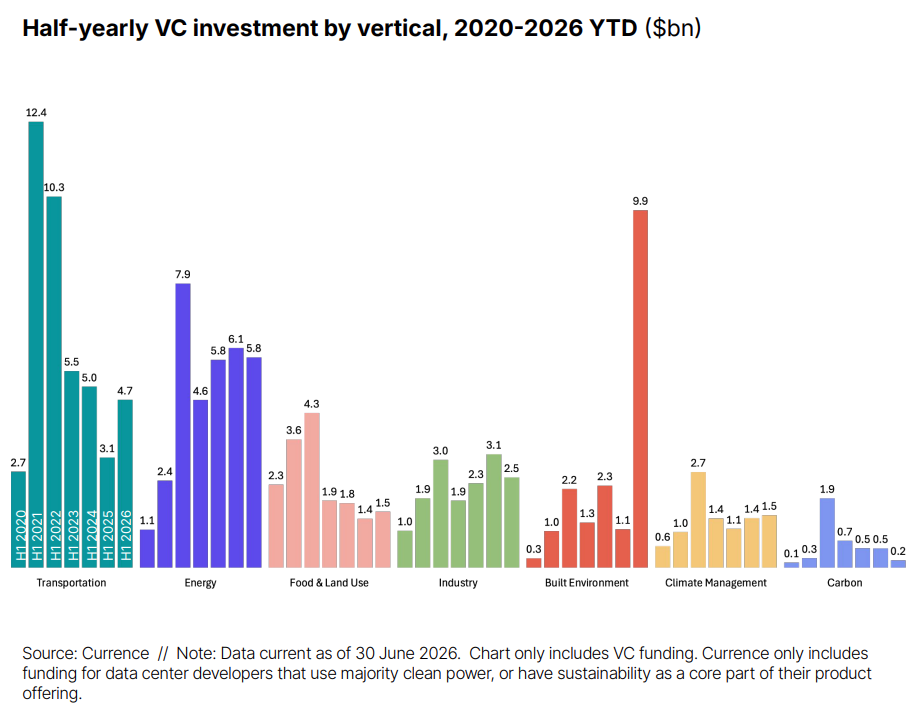
Climate tech investment reached $26 billion during the first half of 2026, according to Currence.ai, up 55% comparted with the same period in 2025. Importantly, the verticals (i.e., the sector or application) in which that capital is being deployed to is changing significant. The trend has been gathering pace over the past few years, but has exploded since 2025. In short, climate VCs are pivoting to where the money is, and funding technologies they judge to be offering the most scalable solutions.
Go back five years ago and Transportation was the main vertical, but since 2021 investment has stalled, dropping by 60%. EV funding still makes up half of the capital deployed in this one vertical, but interest in SAF and other low carbon fuels has evaporated due to policy uncertainty. Meanwhile, investment in nature restoration and ecosystem services (and other technologies under Food & Land Use) have also experienced a similar withering decline.
The biggest drop is reserved for Carbon which has seen the air being sucked out of it as regulations that curb emissions have been slashed or are pushed back. Overall climate VC funding for CCS, CDR, and other technologies that avoid emissions or remove carbon from the atmosphere has dropped by 90% since 2021. Although strong state level climate policies remain in place, federal regulations curbing emissions have been torn up. It's not where the money is right now.
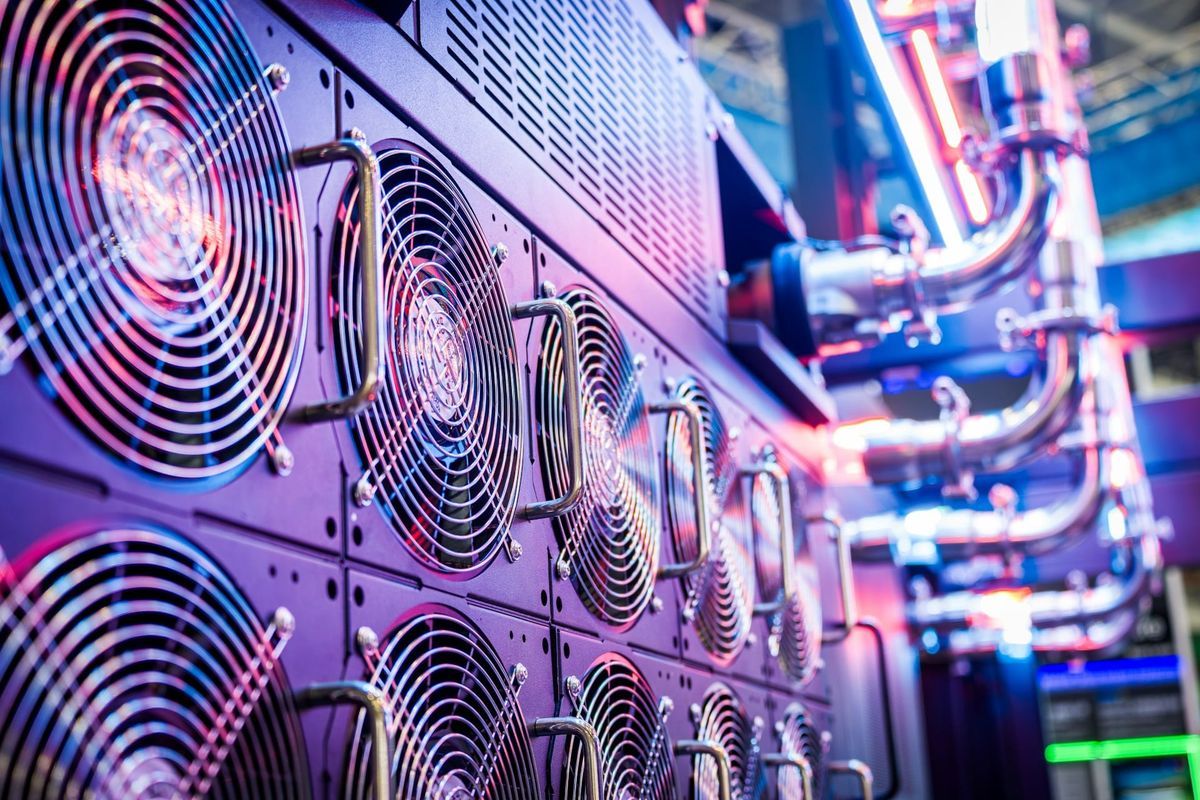
Built Environment (largely 'low-carbon' data centres) accounts for more than one-third (34%) of the investment deployed during H1 2026, recently overtaking energy as the largest vertical. But as the WSJ article explains, for many investors there's an underlying tension in their revised approach. Left unchecked global emissions from AI data centres will rise seven-fold by 2030 to more than 0.7 Gt CO2 per year according to Accenture Research, accounting for 3.4% of global CO2 emissions. Climate VCs may be able to justify it if they can demonstrate a decline in carbon intensity - making a problem not quite as bad as it could have been!
A Faustian bargain
For better or worse, data centres are where the money is, at least while the capex boom continues. One VC-backed direct air capture (DAC) start-up that is chasing the energy trade now that federal support for carbon removal has dried up is Spiritus. Rather than sequestering the CO2 it captures under the ground, Bloomberg reports that it has pivoted to selling the CO2 to US-based producers wanting to inject it into oil and gas reservoirs to improve extraction.
Injecting high-pressure CO2 into an oil reservoir can recover up to 60% of the oil remaining in a reservoir EOR. The US Department of Energy (DoE) estimates that between 84 and 181 billion barrels of crude oil could be extracted using the process in the US, equivalent to between 15 and 35 years of annual crude oil production. It might be anathema to some, but oil and gas are likely to remain a key part of the energy system for decades to come, and at least we should try to do is decarbonise its production (see Amping up: Electrification of oil and gas production is controversial, but necessary).
Until now the US energy industry has relied on organic CO2 deposits, but to access additional oil and gas reserves it will need to get alternative sources of CO2, and that's where DAC comes in. Placing DAC plants closer to wells could dramatically reduce the need for thousands of miles of CO2 pipelines to be laid, eliminating any concerns about CO2 leaks in residential areas (see US 'energy dominance' will depend upon CO2).
Pairing DAC with oil and gas production could tilt the learning curve meaningfully, enabling capture costs to drop from around $500 per tonne to closer to $100 per tonne CO2. This is the concept first identified by Theodore Wright who determined that for every cumulative doubling in the number of airplanes produced, management learnt how to devote human and physical capital more effectively, and began to realise a consistent percentage decline in the cost of production (see How modularity will supercharge growth in Direct Air Capture (DAC)).
If DAC reaches a consistent learning rate of 12% (broadly equivalent to that of the offshore wind industry) then $100 per tonne CO2 should be reached sometime in early 2040's. Let's be clear though, it's early days. Spritus' first operational DAC plant to be situated at the site of an oil and gas producer is expected within the next two years. If it is successful in stimulating a decline in DAC costs, it will increase adoption by other industries, including those described as 'hard-to-abate', and could precipitate even faster cost declines.
Low-carbon commodities are struggling to garner a premium right now, but that's unlikely to continue indefinitely. At some point in the future - when energy security concerns fade and the political compass shifts once again - low carbon intensity commodities (and crude) will be able to generate a premium. While certainly not carbon neutral, DAC plus EOR should dramatically lower the carbon intensity of US crude and gas production, forcing more carbon intensive grades to be priced at a discount, or else their producers being pushed out of the market, lest they fail to curb their own emissions.
Do you need help crafting your perspective on the issues Carbon Risk covers?
Two sides of the same coin
The vertical categories used by climate VCs to signal where they're invested are outdated, and could mean that opportunities to make an impact, while also generating better returns, have gone begging. Take Food & Land Use, Climate Management (remote sensing, emissions reporting, etc), and Carbon as example verticals. A cursory glance at the chart earlier shows that climate VC-backed funding for these verticals has slumped, in both absolute and relative terms.
This is a mistake, and fails to recognise the opportunities once these energy hungry businesses begin to price climate change risks. For the hyperscalers operating huge networks of data centres, rapidly rising emissions and water scarcity "will inflate costs, stress supply chains and expose companies to regulatory risk, carbon taxes and stakeholder backlash," according to Accenture.
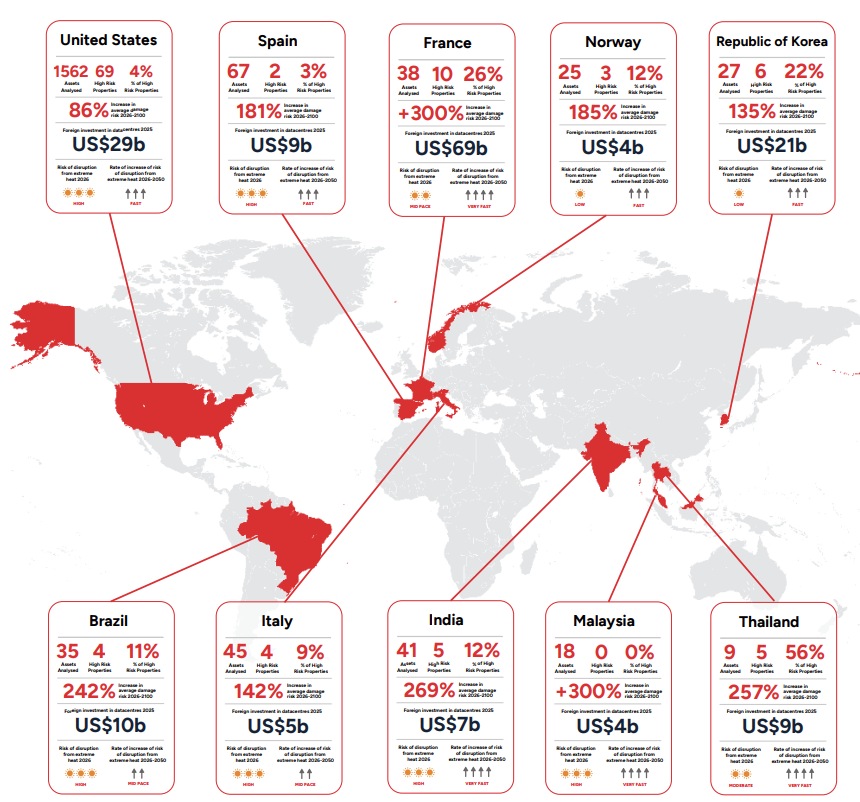
Meanwhile, exposure to extreme weather is also an increasing risk. In North America, approximately ~5% of planned data centres are at high risk, based on XDI's 2026 Global Data Centre Physical Climate Risk and Adaptation Report. The risks posed by extreme weather are significantly higher elsewhere, rising to as high as 20% in South East Asia according to XDI.
Instead of treating them and other verticals as separate buckets to be allocated money on an individual basis, climate VC's should take a more holistic approach. A new report from the United Nations Environmental Programme (UNEP) argues that we should treat carbon mitigation and climate adaptation as interdependent and mutually reinforcing – contrary to the suggestion by some that we should just abandon the former and focus our efforts on the latter (see Climate change is showing its claws - it's time to adapt).
Mitigation contributes to adaptation. For example, restoring forests and planting trees helps to capture carbon, canopy cover reduces the need for energy intensive and emissions intensive cooling, while a thriving local ecosystem also reducing the likelihood of local water shortages or exposure to extreme weather.
On the flipside, adaptation can also contribute to mitigation. Geographical diversification of data centres lessens the impact on local power grids, reducing the chances of a backlash from the local community. Meanwhile, adopting a more distributed system increases the incentive for renewable energy developers to supply data centres 24/7 electricity demands.
And so rather than see each of the buckets as something different, climate VCs should recognise the mitigation and adaptations interdependencies, across all sectors of the economy, but especially where the money is right now – the growth in AI data centres.
The long view
Remember that outside of the US (and to a lesser extent New Zealand), the rollback in climate ambition and policy has (so far at least) been limited. From the perspective of a climate VC based in New York at least, saying that "decarb is dead for now" is probably correct when it comes to America's government regulations and incentives. But that's not the case everywhere.
Take carbon pricing. It cover almost 30% of global emissions according to the World Bank, comprising carbon taxes (broadly stable at ~6%) and emissions trading schemes (almost 25%, up from 8% in 2016). Over the next 5-10 years the share is expected to rise by 10 percentage points to around 40%. First, as China and the EU expand the share of emissions covered by their ETSs. Followed soon by India, Brazil and Turkey as they launch their own compliance carbon pricing schemes.
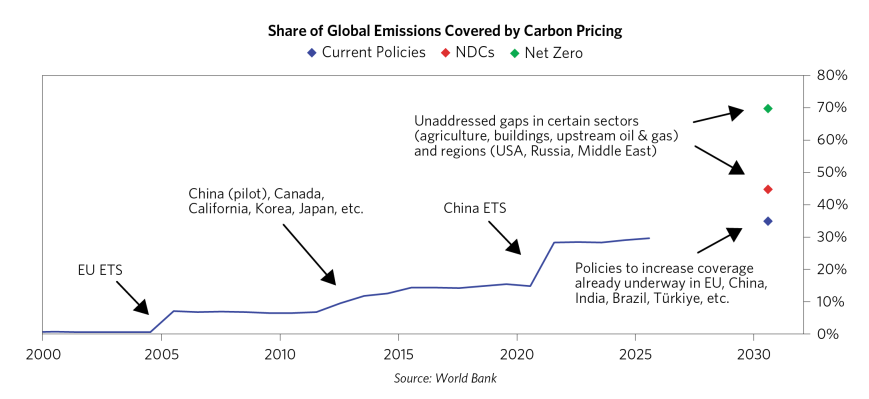
In contrast to the brittle subsidies and incentives since withdrawn by the US federal government, the EU ETS is not some fly-by-night climate policy that gets binned at the first sign of trouble. It's been in place for more than 20 years, emerging stronger even after the Great Financial Crisis, the European sovereign debt crisis, and the recent energy crisis. To this day the EU carbon price remains the only single uniform price across the continent.
The EU has been exporting carbon pricing through trade. For Europe's trading partners, CBAM (which entered its full compliance phase at beginning of the year) is a strong incentive to launch a carbon pricing scheme. The EU's carbon rules give it (and other countries that adopt them) leverage with which they can manage the energy transition, dictating the carbon terms necessary to import goods into their markets. As CBAM coverage expands (perhaps to 17% of extra-EU goods imports) it creates markets for low-carbon materials and services that may not exist elsewhere.
The EU ETS is also moving towards becoming a vehicle that supports industrial competitiveness and decarbonisation. More emphasis on the "cap-and-invest", less so on the "cap-and-trade". In time that should mean that a significantly larger share of the revenues raised by the auctioning of emission allowances get re-directed to help firms invest in the technologies they need to decarbonise. For those climate VCs which have concluded carbon mitigation is dead, that feels like a missed opportunity to me.
Bringing it all together, if rapidly rising energy use provides a launchpad for DAC and other climate technologies, then any resulting increase in consumption emissions may be a small price to pay if the technology goes mainstream - especially if it provides an economic alternative to carbon mitigation. As the emergence of solar panel manufacturers in China exemplifies, commercial decisions made 10-20 years ago have led to global domination today. Carbon removal is a massive prize for anyone who wins it, however it is achieved.
Climate VCs need to talk a smarter game though, multiple verticals are really all about the same interdependent game: carbon mitigation and climate adaptation. As climate risks escalate data centres will become increasingly exposed to these risks. Just because they operate in the cloud doesn't mean they escape their responsibilities.
Finally, its clearly wrong to say that there isn't a government constraint on carbon emissions through taxes or other types of pricing mechanism. The US is certainly an exception to the rule, but away from its shores around one-third of global emissions are priced. What's more the trend is accelerating as large economies such as Turkey, Brazil, and India launch their own schemes. In time more of the world's manufacturers will need to be low-carbon if they are going to remain in business.
Decarb is dead. Long live decarbonisation.
 Peter Sainsbury