Resisting the siren's call
Europe's climate policymakers should continue to offer "forward guidance"


Welcome to Carbon Risk — helping investors navigate 'The Currency of Decarbonisation'! 🏭.
Carbon Risk contributes 1% of its revenue to Stripe Climate, helping to scale permanent carbon removal technologies
Read this article and more with a 30-day free trial
In August 2013 Mark Carney took over the helm at the Bank of England. One of his first actions as governor was to unveil a bold innovation to British central banking: "forward guidance". First employed by the US Federal Reserve the previous December, forward guidance is the practice of communicating likely future actions of the central bank in order to influence present behaviour.
Forward guidance exists on a spectrum. The weaker variety, sometimes called "Delphic" guidance after the oracle of ancient Delphi, involves policymakers signalling their expectations for how monetary policy will evolve over coming months. The stronger form known as "Odyssean" guidance sees policymakers committing to not adjust policy until some specified economic conditions have been met.
This summer Kevin Walsh became the new governor of the Federal Reserve. Even before being appointed he made it abundantly clear his dislike for forward guidance. “I don’t believe that I should be previewing for you what a future decision might be”, he stated in his confirmation hearing.
Subsequent policy statements issued after each Fed meeting have become notably sparser, and any language referring to what the central bank might or might not do has been stripped out. The response from market participants has been far from glowing, with many concerned that Walsh's words appear "confusing" and, even worse, "nonsense".
For financial markets always wary of nasty surprises, forward guidance helped reduce the perception of uncertainty. Take that away and investors are left in the dark, and may suddenly have to readjust their expectations if reality turns out radically differently, in turn leading to a surge in market volatility. The upshot is likely to be an increase in the term premium, the extra yield investors demand to hold long-term debt instruments.
The new governor is quite right to be concerned that central banks are not all-knowing, and that forward guidance can incorrectly anchor market expectations to an outlook that quickly becomes obsolete. However, as Robert Armstrong cautions in the Financial Times, perhaps the biggest part of what a central bank does "is provide a credible anchor for collective beliefs about the price level."
Will this new practice of saying as little as possible catch on with other central banks? It's too early to say. Andrew Baily, Mark Carney's successor as governor of the Bank of England, as well as their opposite number at the European Central Bank (ECB) have both spoken of the pitfalls of forward guidance. As the Bank of International Settlements (BSI) remarked recently, the communication style of central bankers has already evolved in recent years. Nowadays they typically place a much greater onus on illustrating and explaining the uncertainty they have to deal with.
What has all this got to do with carbon markets and the EU emissions trading scheme specifically? Well, as I outlined in Whatever it takes and Forward guidance, high profile European climate policymakers have increasingly sought to shape carbon market price expectations, blending both Delphic and Odyssean approaches to forward guidance. The practice has become more common since Europe was rocked by the Russian invasion of Ukraine and the subsequent energy crisis:
“Much like central bankers, the EU’s politicians want a Goldilocks scenario: not too hot so that the carbon price reaches socially unacceptable levels, nor too cold that decarbonisation technology isn’t incentivised.
By providing forward guidance, the EU hope to conjure up the magic of the central banks: suppressing carbon price volatility, lowering the cost of net-zero capital, and spurring the investment required to pivot away from Russia and achieve its climate change ambitions.”
Peter Liese MEP, the lead lawmaker who steered EU ETS reform through the European Parliament, and Jos Delbeke, a key architect of the EU ETS, have both sought to steer market expectations towards a certain price range. Intervention has typically come in the some form of strong words, either to stop the carbon price from rising too high too fast, or to put a floor under the market if it falls too low.
More recently, at the European Council meeting on 19th March, European Commission President von der Leyen announced plans to develop a new "ETS investment booster" with a budget of "about €30 billion, financed by 400 million ETS allowances." A carbon price of €75 (€30 billion / 400 million EUAs) rapidly became an important marker in the sand at a time of immense uncertainty over the future of the scheme.
Carbon Risk offers flexible subscription options to suit all needs
- Need to create a corporate account with a purchase order?
- How about a group access discount?
- Want to get even more value with a 2 or 3 year contract?
Simply reply to this email to enquire.
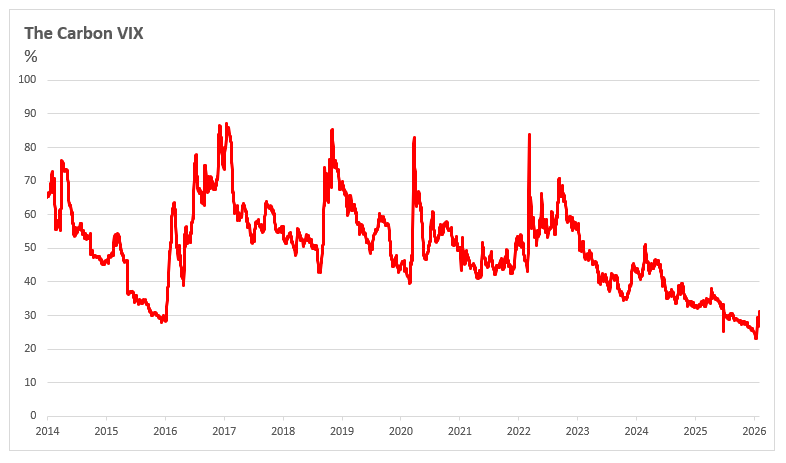
What impact has forward guidance in the EU carbon market had on volatility? The Carbon Volatility Index (VIX) is a market-based high-frequency measure of carbon price uncertainty developed by researchers at the Copenhagen Business School and NYU Stern. The VIX exhibited an average annualised expected volatility of 54% between September 2013 and December 2022 (see The Fear Index).
Since 2023 onwards volatility has fallen consistently, dropping to a record series low of 23% in September 2025. Although there are likely to be a number of other factors at play, developments in the VIX could indicate that forward guidance has helped to dampen volatility.
This is important since lower carbon price volatility should help drive Europe's progress in decarbonising its economy. The academics behind the Carbon VIX found that a 10% increase in the Carbon VIX has the same detrimental impact on investment in decarbonisation as a €12 per tonne decline in the carbon price.
It's clear that Liese, Delbeke, and von der Leyen have at least been successful in steering price levels in the short to medium term, but what about the long-term? Climate policymakers need to employ realistic assumptions over the future marginal carbon abatement cost, while also being mindful of the risk of political blowback if carbon prices rise too rapidly (see The Carbon Laffer Curve).
While not a carbon price forecast, the European Commission's communications is also instructive of what policymakers currently see as a realistic long-term level. The Impact Assessment (IA) underpinning the current ETS reform package assumes "an average price of €150 over the period [2031-2040]".
Of course, circumstances change. ETS reviews only happen infrequently, typically occurring towards the end of a particular phase of the scheme (Phase 4 covers the period 2021-2030). The Commission's views on long-term carbon prices may well be very different come the end of the decade.
It's also worth noting that assumptions within IA's have proved to be a very weak anchor of long-term carbon price expectations in the past. Around the time of the last EU ETS review the Commissions assumptions for the carbon price during the 2020's were much lower: around €20 by 2025, rising to €50 by 2030.
The bout of political turmoil in February reopened this can of worms. President Macron of France appearing to reference these levels as where the ETS "should be", less than half of where the carbon price was trading when he made the remarks.
This brings things full circle.
The Commissions review into the EU ETS was published in mid-July. There will now be several months of negotiation between MEPs and Member States. The target date to secure an agreement is currently thought to be Q1 2027. As groups come together to thrash out the details Europe's climate policy chiefs may fade into the background. It is the summer holidays of course, but since publication date there has been no indication from officials what range of carbon prices represents a credible anchor.
When conducting monetary policy its important to appear credible; that you understand what's going on, you recognise the uncertainty, and that the market can count on you to deliver against your mandate. The same can be said for climate policy.
If Europe's climate policymakers fall silent and follow the new Fed governor's lead, then what's left is a void, one that could easily be filled by the sounds of sirens unconcerned as to whether they interrupt the carbon market price signal, nor undermine the EU ETS' hard-earned credibility. That could lead to a spike in the Carbon VIX, and present a headwind to Europe's need for further investment in decarbonisation.
 Peter Sainsbury