Institutions matter, a lot
On why carbon credit markets are "trapped in a low-volume, low-integrity equilibrium"

Welcome to Carbon Risk — helping investors navigate 'The Currency of Decarbonisation'! 🏭.
Thank you to all the lovely subscribers that have taken out a paid subscription. Your support is much appreciated. Carbon Risk contributes 1% of its revenue to Stripe Climate, helping to scale permanent carbon removal technologies.
If you enjoy this article please share it with someone, and check out the Table of Contents for more insights.
The defining weakness of current domestic carbon credit regulations is not a lack of integrity criteria, but an absence of enforcement. The upshot, according to a new report from the Blavatnik School of Government (BSG) at Oxford University, is that carbon credit markets are "trapped in a low-volume, low-integrity equilibrium." However, getting out of this rut will require more than just the mere threat of better enforcement. A root and branch strengthening of every participating countries institutional capacity to deliver is needed.
Let's start at the beginning. Carbon credits enable emissions to be abated, or carbon to be removed from the atmosphere, in the least-cost way possible. This makes them attractive to corporations wanting to demonstrate their commitment to tackling climate change, and as a means of meeting part of their obligation in carbon compliance schemes. They represent fungible units across both voluntary and compliance markets. In theory at least, one tonne CO2 equals one tonne CO2, whenever and wherever avoidance or removal occurs.
Almost two-thirds of emissions trading schemes and almost one-fifth of carbon taxes allow eligible carbon credits as a compliance option according to the World Bank. Furthermore, multi-jurisdictional schemes, such as CORSIA (the Carbon Offsetting and Reduction Scheme for International Aviation) allow airlines to buy approved carbon credits to meet their obligations (see No carbon copy: Emissions trading schemes are ploughing their own furrow, and that's a risk to future growth).
The big prize though is establishing the international trade in Article 6 compliant carbon credits. Europe's policymakers are now reckoning with how to reform the cornerstone of the blocs climate policy, the EU ETS: to ensure that it remains politically viable, economically sustainable, and most importantly, retain its social license to operate. One option to relieve the pressure is to enable a greater share of the burden to be taken though Article 6 compliant international carbon credits (see Coming of age: The evolution of carbon credits fits a pattern of financial innovation).
Up until recently, European policymakers have signalled caution in extending the influence of international carbon credits to the EU ETS. However, a draft compromise deal on revisions to the EU ETS from the Irish Presidency proposes adjusting the linear reduction factor (LRF) in line with expected purchases of compliant credits. Many policymakers are concerned that this could dilute the EU ETS' hard-fought reputation as a sound 'Currency of Decarbonisation' (see Has Europe learnt from its great carbon price debasement?).
Trust of course is the bedrock of the carbon credit market, whether its the voluntary market, domestic compliance schemes, or the international market for Article 6 credits. As the BSG report makes clear, buyers of carbon credits will only commit "if they can trust that a credit represents a real and durable generated tonne, and that they can use it without reputational or legal risk”, while suppliers will invest "only if demand is predictable," and the rules and regulations governing the development of carbon projects are robust.
Unfortunately confidence has taken a knock in recent years, as reports emerged indicating that the quality of certain carbon credits may not be as strong as advertised. For example, in early 2023 The Guardian and Die Zeit published an investigation into rainforest carbon abatement credits, jointly carried out with SourceMaterial, a non-profit investigative journalism organisation. The researchers analysed the performance of REDD+ credits issued by Verra, the largest verification body, concluding that “more than 90% of rainforest carbon offsets by biggest certifier are worthless.”
The impact on the voluntary market was severe. After reaching a peak of $2 billion in 2021, the market has since dropped by around 75%, according to Ecosystem Marketplace, while transactions have reportedly declined to their lowest level since 2018. Meanwhile, although the number of bilateral carbon market agreements under Article 6 has risen to 113 as of July 2026, according to the Institute for Global Environmental Strategies (IGES), the actual number of carbon credits transferred has so far at least, been very low.
BSG believe that the carbon credit market is currently in a "low-volume, low-integrity equilibrium", whereby low integrity depresses demand, and low demand in turn weakens the incentive to invest in integrity. As Carbon Risk has documented previously, the carbon credit market has an adverse selection problem, whereby the only sellers prepared to accept a low price, are those who know they are offloading a poor quality carbon credit. The poor cost-benefit ratio (effort required versus carbon price received) weakens the incentive for any supplier of carbon credits to do better (see Carbon's "lemon" dilemma).
The actions of the Open Coalition on Compliance Carbon Markets (and several other coalitions of like-minded governments) to ensure greater interoperability across carbon markets will mean little if the foundations upon which it is built fails to stand up to scrutiny. Breaking out of the "low-volume, low-integrity equilibrium" depends on improving the quality of the underlying domestic rules they seek to build on and connect (see Join the club).
Although high-integrity criteria is fast becoming a feature of domestic crediting rules, BSG's analysis of Oxford Climate Policy Monitor (OCPM) survey data show that while the rules have become more ambitious, and the quality of implementation has climbed steeply (especially since 2023), the degree of stringency underpinning those rules has risen only slightly.
The number of carbon crediting polices in force has increased almost 10-fold since 2020 to 125 as of mid-2026, according to new data from the OCPM representing 39 jurisdictions and covering 90% of global GDP. The table below shows the regulatory quality of crediting rules in each jurisdiction: from generation (covering the main risk factors that determine whether a carbon credit will deliver on its claims), through to implementation, and finally, the weak link - stringency.
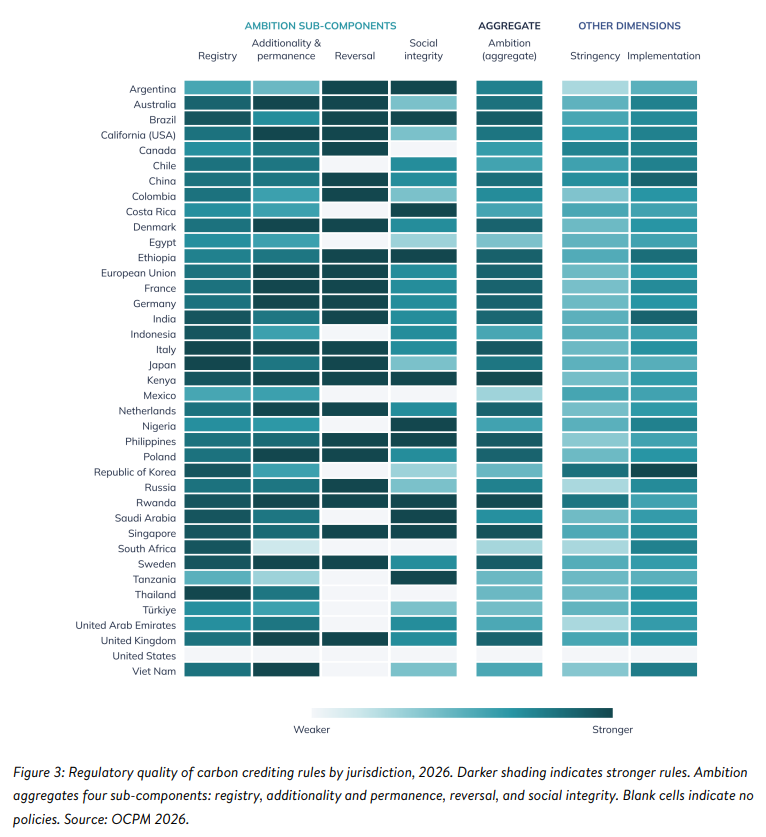
The BSG report makes four key observations regarding the quality of carbon crediting rules by jurisdiction, broken down by generation, implementation and stringency.
First, the majority of jurisdictions have weak safeguards in place to cover reversal risk (a key risk in nature-based solution projects), and social safeguards (whether local communities are consulted and share in the benefits). While reversal safeguards tend to be weakest in emerging economies, social safeguards are often stronger relative to more developed countries.
Second, demand for carbon credits is being created faster than guardrails are put up to constrain their use. This is most evident in emerging economies. A government might specify which credits are eligible in its compliance scheme, but not impose any limit on their use. This asymmetry extends to the voluntary market with suppliers facing detailed integrity requirements, but buyers only facing transparency demands.
Third, the infrastructure for exchanging carbon credits within jurisdictions (the national registry) is well established. The gap according to BSG lies in what happens when credits cross borders. For example, rules against double counting (so-called corresponding adjustments) are missing in a third of jurisdictions. Meanwhile, with the legal status of credits only defined by a handful of countries, there is a risk that the infrastructure for trading credits "develops apart from the rules that govern what is being traded."
Fourth, the ad-hoc way in which methodologies for generating carbon credits and standards for their use have been introduced means that each country has their own version. Meanwhile, criteria often refer to external standards (such as the Article 6 rulebook), rather than an actual law. The upshot is that regulators have limited means to enforce how credits are generated or used.
This "lack of binding force" is the defining weakness of today’s carbon credit regulations, according to BSG. The report correctly recommends that governments should turn standards into binding duties, backed by sanctions with enforcement levels tracked.
If only it were that easy, as the experience in the EU ETS makes clear.
As I discuss in Straight and narrow, research by Georgetown University and the Grantham Research Institute found that 98.8% of installations in the EU ETS have complied with the regulation since 2006 - an official non-compliance rate of 1.2%.
Although the probability of non-compliance with the EU ETS appears to be associated with the size of the penalty and the probability of enforcement, the researchers estimate that it only explains around one-tenth (12%) of the variation in compliance.
Beyond fining, their analysis found no compelling evidence regarding the effectiveness of other regulatory tools: having more oversight over third-party auditors, naming and shaming those who fail to comply, using regulatory discretion to reduce free allowances for offenders, or perhaps most surprisingly, even on-site inspections.
The most likely reason for the high level of compliance in the EU ETS is Europe's institutions. As in other areas of regulation, the institutional capacity of a country shapes its ability to adopt and enforce policy sticks. If carbon credit buyers and suppliers don't trust that methodologies and standards will be enforced then its unsurprising that carbon markets become "trapped in a low-volume, low-integrity equilibrium."
This lack of trust in institutional capacity makes us all worse off.
It means that a global market in Article 6 carbon credits is likely to suffer repeated delays. Any action to help governments enforce carbon credit regulations must consider broader institutional improvements first.
It means that industrial emitters will need to shoulder more of the emission reduction burden, at a much higher cost than could have been achieved using high-integrity carbon credits.
Last, but not least, it makes meeting the $250 billion annual funding gap necessary to meet global biodiversity, climate and land restoration targets significantly more difficult, and increases the onus on other sources of public and private capital to step up.
 Peter Sainsbury