Against the grain
Rice feeds half the world, yet its cultivation is a major source of methane emissions, and future yields are vulnerable to climate change. Google may have the solution!

Welcome to Carbon Risk — helping investors navigate 'The Currency of Decarbonisation'! 🏭.
Carbon Risk contributes 1% of its revenue to Stripe Climate, helping to scale permanent carbon removal technologies. Thankyou to all the subscribers that support Carbon Risk.
If you enjoy this article please share it with someone and check out the Table of Contents for more insights.
Rice cultivation emits around 35 million tonnes of methane per year, representing around 10% of man-made methane emissions.
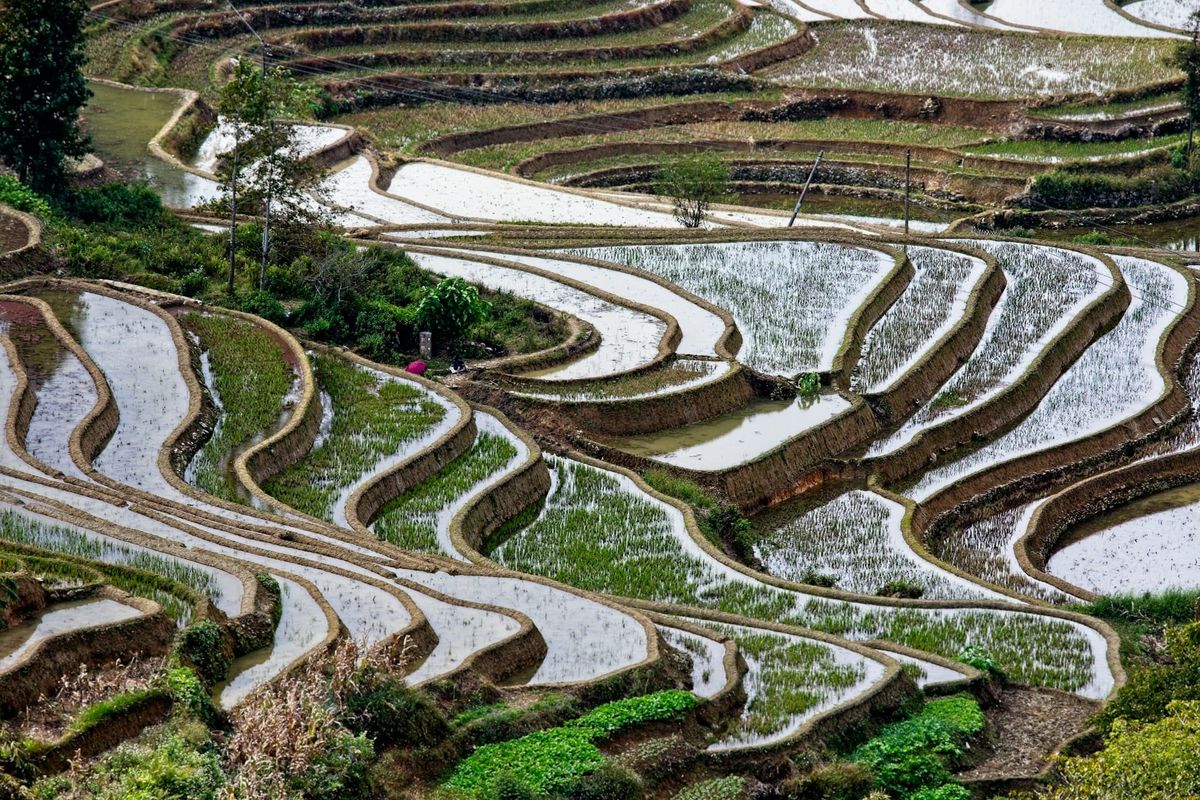
The superpollutant is produced through the anaerobic decomposition of organic matter and is responsible for between 35% and 50% of net global warming to date. These conditions are particularly potent in rice cultivation as more than three-quarters of global rice production takes place in stagnant water.
Methane bubbles to the surface of rice paddies across a swathe of south-east Asia spanning 165 million hectares. The region, known as Monsoon Asia, numbers more than 20 countries including China and India. These two countries alone are responsible for 50% of global methane emissions from rice cultivation.
Green revolution 2.0 required
Rice already feeds more than half the world. But in order to meet expected demand due to population growth, global rice supply may need to grow by 30% over the next two decades. However, unless rice cultivation becomes much less methane intensive, the impact of rice paddies on the climate is likely to grow.
What's more, rice production is perhaps the staple crop most at risk from climate change. Higher temperatures, more volatile weather patterns, and drier conditions are likely to curb yields. This makes finding a solution to rice's methane problem especially pertinent (see Climate change is showing its claws - it's time to adapt).
One of the cheapest and most effective techniques for cutting methane emissions from rice paddies is Alternative Wetting and Drying (AWD). Instead of cultivating rice from fields that are permanently flooded, AWD involves periodically drying and re-flooding the fields.
The technique could cut methane emissions by 40-45%, according to the World Resources Institute (WRI), although this will vary significantly depending on irrigation methods, soil types, and the type of fertiliser used. Rice cultivation is highly water intensive, accounting for ~30% of the worlds demand for irrigated water. Another benefit of AWD is that it has been shown to curb water usage by 30%, something that's likely to become even more important in the future.