Canadian climate policy and the politics of the possible
Mark Carney leads with carbon competitiveness and global impact over hitting national emission targets

Welcome to Carbon Risk — helping investors navigate 'The Currency of Decarbonisation'! 🏭.
Carbon Risk contributes 1% of its revenue to Stripe Climate, helping to scale permanent carbon removal technologies. Thankyou to all the subscribers that support Carbon Risk.
If you enjoy this article please share it with someone and check out the Table of Contents for more insights.
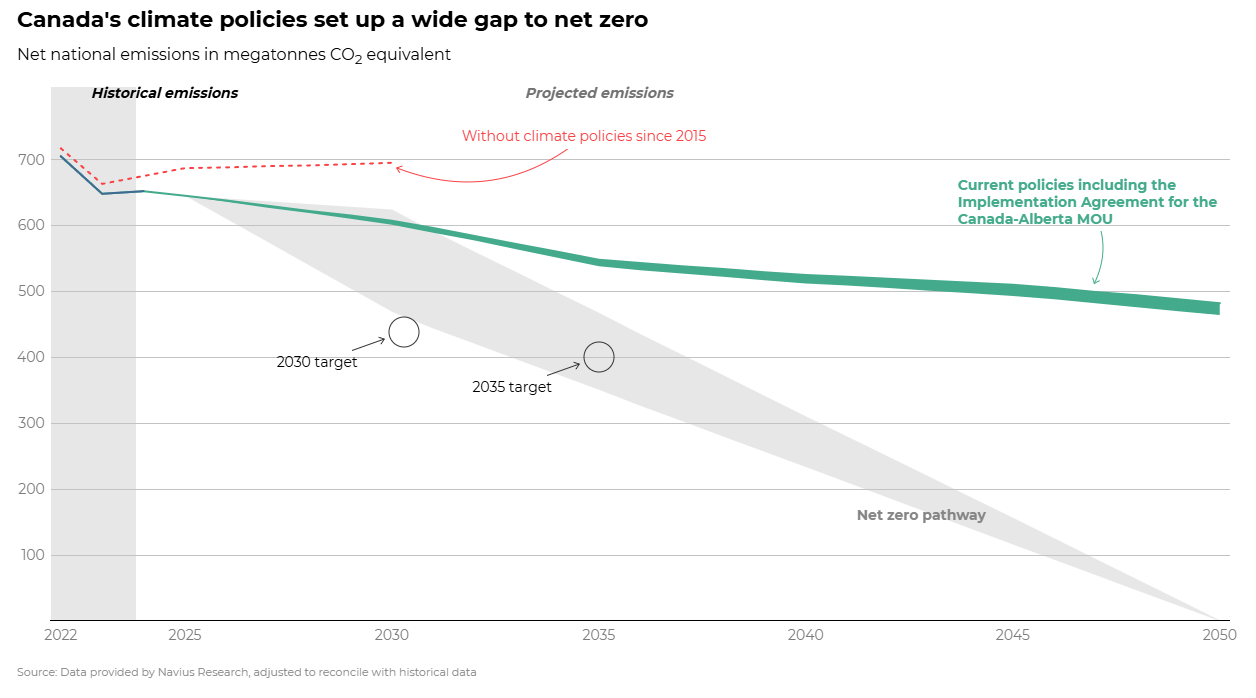
Canada is more than 20 years behind its 2030 emission reduction target according to the latest projections commissioned by the Canadian Climate Institute (CCI).
Climate policies introduced by the Liberal government since 2015 have helped to bend the trajectory lower. However, since spring 2025, when Mark Carney became prime minister, federal and provincial level climate policies have typically been removed or weakened. The upshot is that Canada's emissions are likely to remain stubbornly high well into the 2040's. Even by 2050 Canada will be lucky to cut its emissions to the levels enshrined in the 2021 Net-Zero Emissions Accountability Act.
CCI's latest analysis focuses on the impact of the Implementation Agreement of the Canada-Alberta Memorandum of Understanding (MOU). The agreement was signed by Alberta Premier Danielle Smith and Prime Minister Mark Carney on 15th May. The MOU involves a fundamental redesign of Alberta's industrial carbon market known as the Technology Innovation and Emissions Reduction system, or TIER. Given that Alberta's carbon market covers about one quarter of Canada's emissions, any changes can have a ripple effect, impacting the emissions profile for around 40% of the Canadian economy.
To recap, the MOU introduce several elements that are supposed to strengthen the market, but that have actually ended up leaving it weaker.
For example, a regulated price floor was introduced that gradually increases to CA$130 per tonne by 2040, equivalent to about CA$110 in today’s dollars. Any credits submitted for compliance must be at least the minimum price set out in the MOU. Alberta has been beset by an oversupply of credits for years, but crucially the MOU (and the price floor) does nothing to correct this. In fact, it makes the problem worse since the floor price is set above that at which the market naturally clears - where demand intersects with supply.
Emitters that are long credits (i.e., they have cut their emissions and so they have a surplus of credits) will only ever be able to sell them at the floor price, but because the market won't clear they will still be stuck with many of their credits. And so rather than try and sell their credits at the floor price, the rational response is to bank them and hope to benefit from a higher carbon price later. The supply of credits that could eventually come back onto the market grows larger and larger.
In short, the policy changes dampen the carbon price in the short-term, curbs the incentives for obligated emitters since there's little point in generating a surplus you can't sell, contributes to poor liquidity that hampers the market operationally, and fails to generate an adequately high carbon price in the long-term to incentivise decarbonisation.
Prime Minister Carney has made other climate commitments: to update carbon pricing standards, introduce tighter vehicle emission regulations, and announced plans to electrifying the economy. Though as CCI state in their report, the likely effectiveness of these measures is difficult to determine given the lack of detail provided so far.
Shifting sands
In return for reforming TIER, Premier Smith has secured a concession to build a east-west oil pipeline to the Pacific coast that will, according to Carney, "unlock Alberta’s energy for the world", and importantly reduce Canada's dependence on the US for its energy exports and pivot towards supplying Asia. Construction is supposed to begin in 2027 with the first oil flowing sometime in 2032 or 2033. CCI estimate that the pipeline could add around 20 Mt CO2e to Canada's annual emissions and is accounted for in the chart above.