CDR "moonshot" aborted, for now
Reboot needed as Microsoft allegedly suspends carbon removal purchases


Welcome to Carbon Risk — helping investors navigate 'The Currency of Decarbonisation'! 🏭.
On the same day that Artemis II returned from its historic 10-day mission to the far side of the Moon, Microsoft appeared to scrub its own "moonshot" as reports emerged that the tech giant has suspended future carbon removal purchases indefinitely.
At the start of the 2020s, tech companies such as Google and Microsoft were confident that they would be powering their date centres using renewable energy by 2030, while employing carbon dioxide removal (CDR) to negate those carbon emissions that couldn't be reduced to zero. Microsoft went further, announcing a 2050 plan to “remove from the environment all the carbon the company has emitted either directly or by electrical consumption since it was founded in 1975."
The race to mitigate the environmental impact of data centres gathered pace with many following the lead set by the major tech companies and adopting ambitious climate targets. The ‘Greening Digital Companies 2025’ report, tracking emissions and climate commitments of 200 leading tech companies, found that almost half had committed to net zero emissions, with 41 firms aiming for 2050, and 51 targeting earlier deadlines.
When the major tech companies embarked on their carbon removal "moonshot" they quickly recognised that CDR was in short supply and the cost was prohibitively expensive. Stripe was the first company to recognise the power of becoming the buyer of first resort, employing advanced market commitments to signal demand, hoping to spur innovation and the development of new CDR technologies (see Carbon dioxide removal and the buyer of first resort: The window for high cost, novel CDR technologies is closing fast).
It's here that the tech companies were following in the footsteps of the first manned trips to the Moon. In the early 1960s NASA realised that early computing technology was too unreliable to ever get a man on the Moon. In response, the US government declared that they would buy every single integrated circuit manufactured – after three years the global market for microchips had grown 20-fold.
Microsoft took the role of CDR buyer of first resort to a new level.
In 2025 the tech giant purchased 52 million CDR credits in 2025 (93% of the carbon removal market), according to data published in the Sustainable Energy in America 2026 Factbook. Almost all (96%) of the CDR volume was contracted via long-term offtake contracts (typically 10–15 years) whereby the buyer commits to purchasing a specific volume of future CDR credits.
The tech giant invested in a portfolio of CDR bets, hedging its CDR exposure across a range of different technologies; initially focused on engineered credits (bioenergy with carbon capture and sequestration), but more recently pivoting to nature-based removals (reforestation). In total, Microsoft is estimated to have contracted more than 80 million CDR credits since 2020, accounting for almost three-quarters of the CDR market (~113 million credits, or 73%).
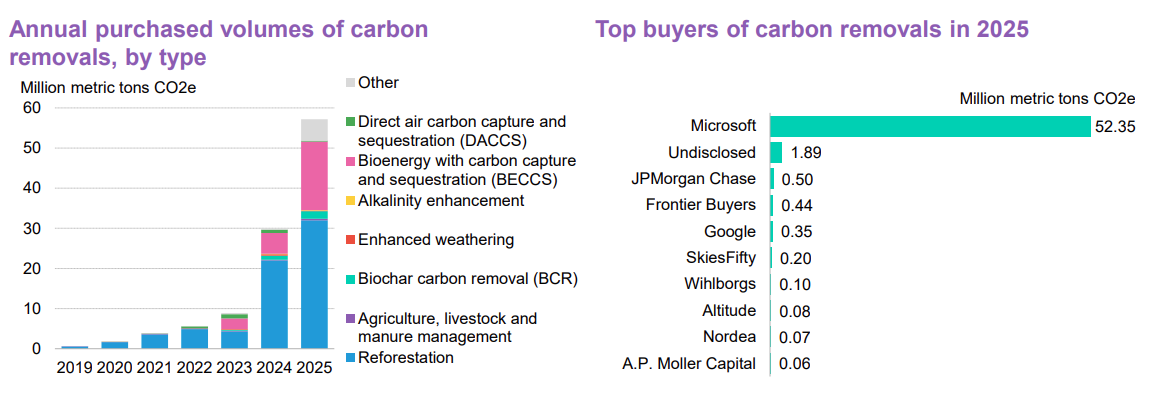
Recent media reports (such as 'Microsoft is the carbon removal market' by Latitude Media) are blunt in their assessment of the tech company's dominant position, arguing that "having one buyer dominate the market isn’t a sustainable strategy long-term." In the absence of regulation forcing firms to act (such as that being considered in the UK, EU, and Japan), some analysts fear that a more diverse set of CDR buyers is unlikely to materialise. Note that the revised Corporate Net Zero Standard from the SBTi does little to incentivise CDR (see Eyes on the prize: Revised SBTi standard amplifies role of internal carbon prices, carbon credits, and Environmental Attribute Certificates (EACs)).
Microsoft's apparent suspension of future CDR purchases leaves a gaping hole. Whether the rumours are true or not, the industry's dependence on one company does leave it structurally vulnerable.
Read the rest of this article with a 30-day free trial*
*and get access to the entire archive!