Brazil's carbon market gets the green light
Policy secures the nation's climate leadership among world's biggest oil producers

On 13th November, Brazil’s Senate approved a bill to regulate the country’s mandatory and voluntary carbon markets. Less than a week later Congress, the legislative body of Brazil’s federal government, also approved the proposals. It now only requires the signature of President Lula da Silva to become law.
The debate over the shape Brazil’s regulated carbon market has been going on since 2009. The policies have received renewed impetus as other large countries have either launched their own carbon markets, or have announced plans to do so. For example, emerging economies such as Turkey, India, and Indonesia have begun to implement emissions trading schemes (ETS), partly in response to the EU’s carbon border adjustment mechanism (CBAM).
Another factor is Brazil’s return to the world stage following four years of climate policy retreat under the leadership of Jair Bolsonaro. Next year it will be Brazil’s turn to host COP. The 30th edition of the climate conference will be held in the Amazonian city of Belém. Brazil is of course no stranger to holding climate conferences. The first UN conference on environment and development, known as the Earth Summit, was held in Rio de Janeiro in 1992.
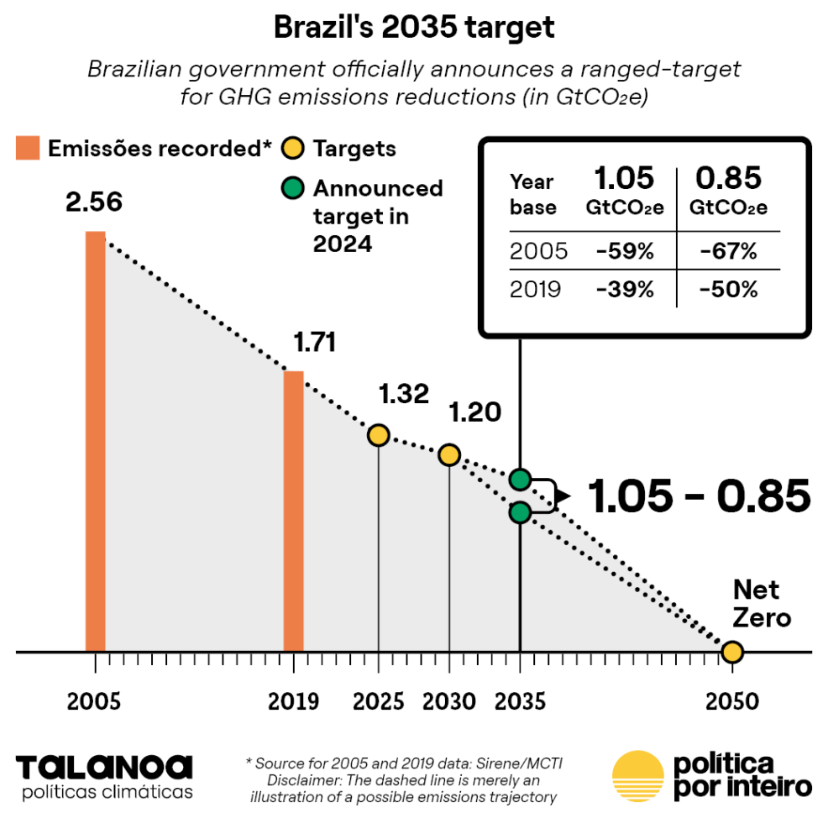
The Brazilian government published its latest Nationally Determined Contribution (NDC) during COP29. The updated climate plan aims to cut emissions by between 59% and 67% from 2005 levels by 2035, (equivalent to an absolute reduction of 850 million to 1.05 billion tonnes of CO2e), achieved mostly by relying on its carbon-storing forests. As a mark of its ambition it has also been pushing other countries to submit their NDCs by February, the UN’s deadline, while also encouraging governments to bring forward their net-zero target dates from 2050.1 2
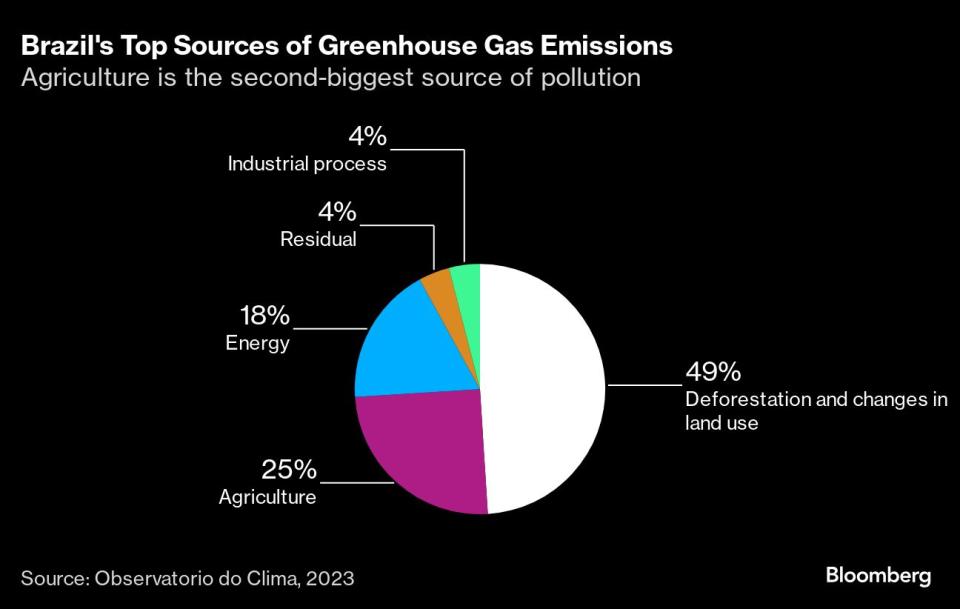
After returning to power in November 2022, President Lula da Silva succeeded in halving the rate of deforestation in 2023, bringing the rate of land clearance in the Amazon down to a five-year low. Land use change is Brazil's largest source of emissions, accounting for almost half (49%) of the country’s greenhouse gas (GHG) emissions, according to Climate Observatory. Forest is often cleared to make way for agriculture, but this is also a major source of emissions, especially methane released by livestock. Overall, agriculture accounts for 25% of Brazil’s emissions (see Repricing deforestation risk in the wake of Brazil's presidential election).3
Nevertheless, beyond cutting deforestation, Brazil will also need to rein in emissions from oil & gas production and heavy industry if it is going to meet its climate targets. A carbon market is the missing link that will help Brazil achieve its carbon ambitions, while also increasing the country’s economic development, and alleviating poverty.
Pricing carbon from oil & gas producers and heavy industry
The ETS will impose reporting obligations on all entities emitting more than 10,000 tonnes of CO2e per year, with those emitting more than 25,000 tonnes of CO2e per year required to meet compliance. These obligated entities will have to surrender allowances for all their covered emissions. Overall, an estimated 5,000 companies are thought to be subject to compliance obligations.
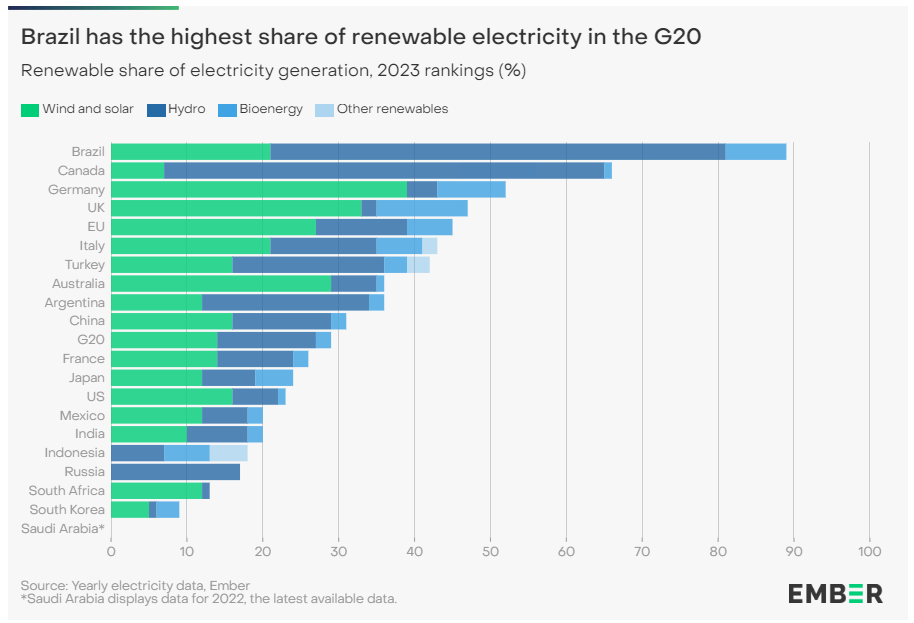
Only around a quarter of the emissions produced in Brazil will be covered by the carbon market, primarily from the oil & gas sector, but also other carbon intensive industries such as cement, iron and steel, and aluminium. In contrast to the EU ETS and other compliance schemes, Brazil has little need to rely on carbon markets to price out fossil fuel power generation. It already has the highest share of renewable energy in the G20 (89%) by virtue of its hydroelectric resources and more recent investments in solar and wind capacity.
It’s to Brazil’s credit that its oil and gas industry will be covered by the cap-and-trade scheme. The country wants to be a climate leader, but it must also generate sufficient capital to alleviate poverty. The answer may lie in becoming a low carbon intensity oil producer. It is currently the world’s eighth largest oil producer, but the government has a goal of becoming the fourth largest. To achieve that it intends to pump increasing volumes of crude from its offshore oil fields, while also exploring for and developing new undersea deposits.
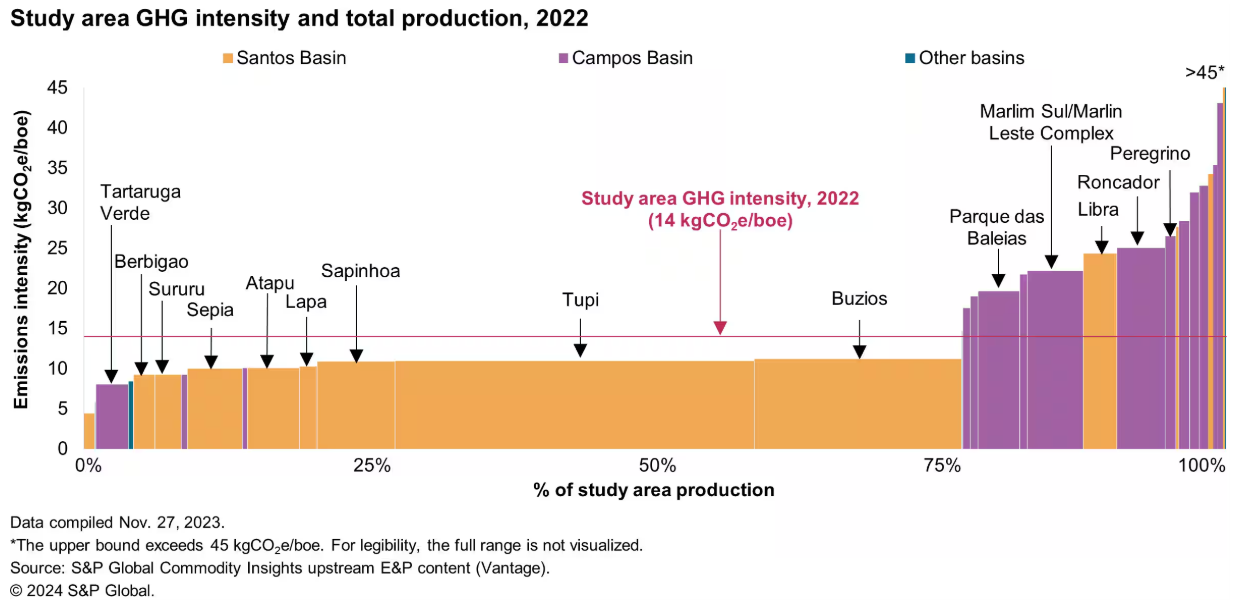
The cap-and-trade mechanism should enable Brazil to continue to grow crude production, while also incentivising producers to cut Scope 1 emissions, bringing them inline with their competitors. A study by S&P Global estimated the emissions intensity of Brazil’s offshore oil fields at 14 kgs of CO2e per barrel of oil equivalent (kgs of CO2e per boe) in 2022. This compares to 11 kgs CO2e per boe for the North Sea and 7 kgs of CO2e per boe for US Gulf of Mexico. Reducing the carbon intensity of fields within the Campos Basin will be crucial to making Brazilian crude more attractive on the global market (see Canada's oil and gas cap-and-trade scheme does not go far enough).4
Critics of the carbon market proposals have accused the government of letting Brazil’s main source of emissions - land use change and agriculture - get off scot-free. However, it’s not unusual for forestry and agriculture to be outside the coverage of carbon markets. In Europe for example, farmers have long pushed back on agriculture’s inclusion based on the difficulty of monitoring emissions, while governments have been wary of food security concerns and the potential impact on food prices.
It’s worth noting that only one country - Denmark - has announced a tax on agricultural emissions, illustrating the challenge in implementing such a policy. Brazil’s proposal also differs from cap-and-trade schemes such as the EU ETS in that it excludes certain agribusiness sectors such as fertiliser manufacturers from compliance obligations (see Bringing home the bacon, sustainably: Denmark's carbon tax on agriculture allays fears of a European green backlash).
Limited exposure to CBAM, but trade risks lie elsewhere
As I highlighted at the beginning of this article, many countries are urgently introducing carbon pricing in response to the EU’s CBAM. The levy is only payable by EU importers if the production country-of-origin does not have a comparable carbon price as the EU’s. CBAM will initially cover cement, iron and steel, aluminium, fertilisers, electricity and hydrogen. Unlike other countries, Brazil is not particularly exposed to the introduction of CBAM (to be phased-in gradually between 2026 and 2034), despite being a major producer and exporter of some of the eligible raw materials.
Exports of CBAM eligible commodities accounted for a 5.8% of Brazil’s total global exports during the period 2020–2022, according to an analysis carried out by the International Institute for Sustainable Development (IISD). Of this subset of exports, around 10% were exported to the EU, which means that just 0.6% of Brazil’s exports are exposed to the EU’s CBAM. The iron and steel sector account for almost all (92%) of the CBAM eligible exports affected.5
However, it could face exposure to CBAMs enacted by other jurisdictions, such as the United States. The Foreign Pollution Fee Act proposes an implicit carbon pricing mechanism for imported industrial raw materials, energy products, and certain minerals. In simple terms, the fee would apply to raw materials that have a higher carbon intensity than US manufactured products. Here the US imports around half of Brazil’s exports of cast ferrous metal, and one-quarter of its refined ferrous exports (see Free rider: Carbon border levies could trump US withdrawal from Paris).
Taking credit for Brazil’s carbon
As in other cap-and-trade markets, obligated emitters who are above their cap will be able to buy emission allowances from other entities who have managed to cut emissions. Furthermore, in the same way that the Californian ETS, and many of the recently launched schemes in Asia, emitters in Brazil’s market will also be able to purchase carbon credits from the domestic voluntary carbon market (VCM).6
The ability to meet even a small proportion of an obligated emitters compliance will result in a significant increase in demand for credits. With the right safeguards in place (i.e., ensuring carbon credit products are of a high quality, coupled with robust monitoring and verification) the additional demand will help to channel significant funds towards the Amazon and other areas at risk of exploitation.
It’s true that Brazil is already a major producer of carbon credits for the VCM, accounting for 6% of carbon credits retired since 2015. In 2021 Brazilian carbon projects supplied 12% of the credits on the VCM, up from 3% in 2019. The International Chamber of Commerce (ICC) believes that the country could cover up to 48.7% of global demand for carbon credits in 2030.
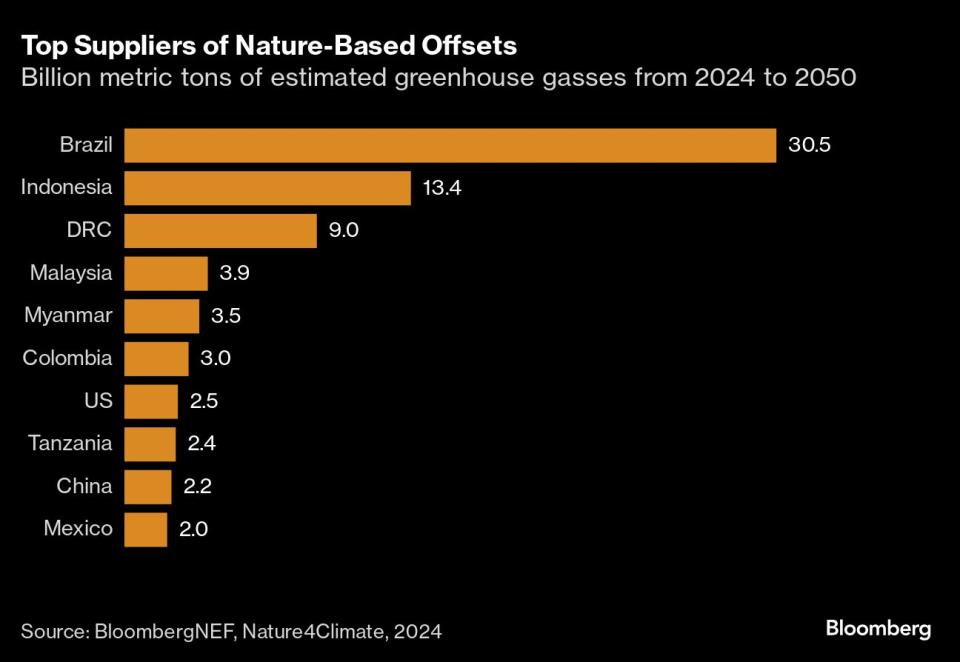
The ICC estimate that Brazil could generate a combined $120 billion in annual revenue from the sale of VCM credits and Article 6 compliant credits, assuming a carbon price of $100 per tonne of CO2e. Taking a longer term perspective, BNEF estimates that Brazil could generate 30.5 billion tonnes in carbon credits between now and 2050, making it by far the dominant player on the global carbon credit market.7
The updated NDC states for the first time that Brazil plans to trade emissions reductions with other countries under the rules of the Paris Agreement. According to the NDC, the government will use the lower-ambition target of 1.05 Gt CO2e as the basis for reporting progress and for mechanisms under Article 6. The opportunity for Brazil to restore it’s lost forests, while also generating capital for the country’s future could be immense. Here’s the Economist’s take from an article published in September highlighting the opportunity for verified carbon credits to save the Amazon:8
“All told, restored Brazilian forests could account for 15% of the world’s potential for carbon removal through reforestation (the only other country that could plausibly match this is Indonesia). Brazil—currently the world’s sixth-largest emitter of greenhouse gases—could be the only large country to become carbon negative. There is excitement in Brazil. The national development bank thinks that the country could lease 2.5m hectares of public land to reforestation companies, generating a huge number of carbon credits.”
A long time to implementation
A carbon market is the missing link that will help Brazil achieve its emission reduction ambitions, and establish a dominant position for the country as a supplier of carbon credits. Unfortunately, it’s doubtful whether the carbon market will have a material impact on the 2035 targets outlined in the NDC. The problem is that it could take several years to implement, leaving little time to bring down emissions, or establish the carbon crediting infrastructure necessary.
According to Centro Brasil no Clima, it is very unlikely that the carbon market will be fully operational this decade. Speaking to Argus a few weeks prior to COP29, a representative from the think tank estimated that the implementation phase could take 5-6 years: the preparation and legal framework could take 1-2 years, pilot testing and initial rollout could take 1 year, and then the submission of monitoring plans and emissions reporting are likely to be completed within 1-2 years after pilot testing has been completed.9
As other major energy producers step back from their role at the forefront of both global and domestic climate policies, Brazil is now stepping into that void. The largest country in South America, the home to the Amazon, Brazil is unique among major economies given it’s legacy of deforestation and its position as a major oil exporter. It’s carbon market will help to decarbonise its energy industry, while cementing it’s place as the dominant player in the market for nature-based carbon removal.
https://www.climatescorecard.org/2023/11/brazils-climate-observatory-has-been-producing-reliable-estimates-of-annual-greenhouse-gas-emissions-since-2013/ ↩
https://unfccc.int/sites/default/files/2024-11/Brazil_Second%20Nationally%20Determined%20Contribution%20%28NDC%29_November2024.pdf ↩
Climate Observatory state that Brazil’s NDC would have to target a 92% cut in emissions by 2035, compared with the 2005 baseline, to be on course for net zero https://www.oc.eco.br/faq-entenda-sobre-a-ndc-do-observatorio-do-clima/ ↩
https://www.argusmedia.com/en/news-and-insights/latest-market-news/2611567-brazil-s-carbon-market-will-not-start-before-2030 ↩
https://www.spglobal.com/commodityinsights/en/ci/research-analysis/ghg-intensity-of-offshore-brazil-production-in-2022.html ↩
Proposed penalties for non-compliance include fines of up to 3% of gross revenue, cancelation of their credit trading registration, loss of credit facilities or tax benefits, and exclusion from government contracts for a limited period of time. ↩
https://www.iccbrasil.org/wp-content/uploads/2022/10/RELATORIO_ICCBR_2022_IN_22.10.21.pdf ↩
https://www.economist.com/the-americas/2024/09/19/can-the-voluntary-carbon-market-save-the-amazon ↩
https://www.iisd.org/system/files/2024-07/border-carbon-adjustments-brazil.pdf ↩