Rule it in
Adjusting the emissions cap according to a fixed formula could be a good idea

Exchange rate volatility imposes a significant and often unpredictable cost on businesses, directly affecting cash flow and profitability in the short-term, while also subjecting long-term investments to a heightened degree of risk. As the 'Currency of Decarbonisation', carbon price volatility also acts as a brake on companies ability and willingness to invest in large-scale low-carbon projects, ultimately slowing the pace at which the economy decarbonises.
The impact of carbon price volatility on investment can be quantified. In the ten years to December 2022, researchers estimate that a 10% increase in the Carbon VIX (a measure of expected volatility in the EU carbon price) had the same detrimental impact on investment as a €12 per tonne decline in the carbon price (see The Fear Index).
The price of emission allowances in the EU ETS and other cap-and-trade schemes is inherently volatile. The supply of allowances is highly price inelastic which means that even small changes in demand can result in large swings in the price of carbon. In the short-term, changeable weather conditions, the price of energy, and climate policy risk mean that demand is also subject to large variability.
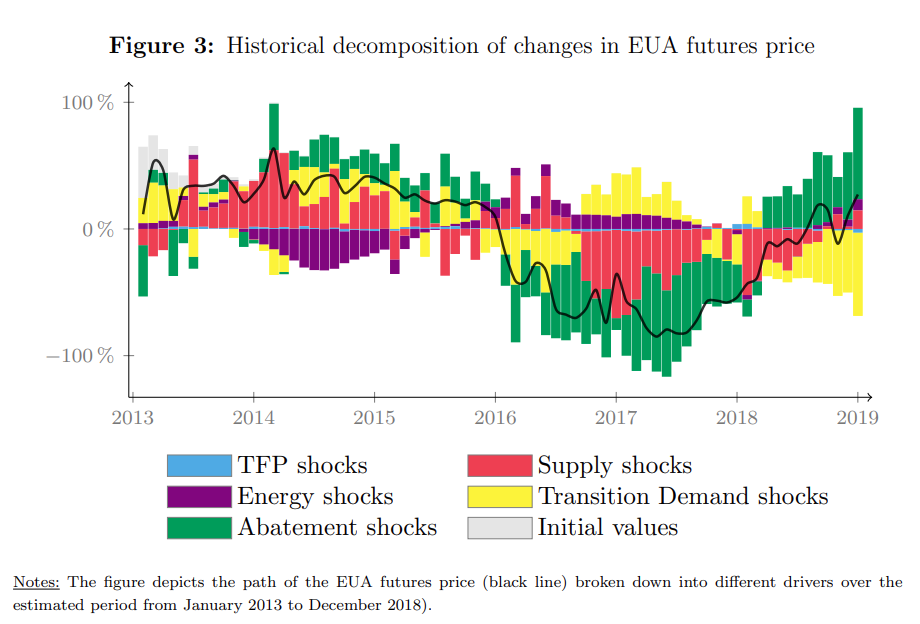
Academics led by researchers at the University of Edinburgh attempted to decompose the influence of these factors during Phase 3 of the EU ETS (2013-19). Although each takes centre stage at various points during the seven years, the main driver affecting the EU carbon price over the longer-term is the marginal cost of abatement. Here, unexpected developments in technological innovation, and swings in the relative cost versus existing technologies can have a significant impact.
The cost of this volatility was quantified versus a theoretical scenario in which the carbon price is aligned with the social cost of carbon (SCC), i.e. the carbon price tracks the net economic damage resulting from an incremental tonne of carbon dioxide (CO₂) released into the atmosphere. The analysts calculated that EU carbon price volatility is about 100 times greater than what would be expected under an SCC aligned carbon price mechanism. The permanent welfare loss associated with this excess volatility was estimated to be between €158 million and €215 million during the period 2013–2018.
Governments have experimented with a variety of mechanisms designed to temper price volatility in cap-and-trade schemes.
This includes price corridors (floors, ceilings and trigger points), smoothing the supply of allowances over time (via banking and borrowing), price containment reserves (releasing allowances if the carbon price hits certain criteria, such as when it increases too high, too fast), and also less formulaic types of intervention (verbal intervention or ad-hoc mechanisms to bring forward allowance supply from future auctions).
The problem with the formal mechanisms used to date is that they typically fail to deliver the required impact, while informal mechanisms are typically open to interpretation and their use can negatively impact market credibility (see A carbon floor price is a bad idea: Meddling in markets built on trust is rarely successful).
Read the rest of this article with a 30-day free trial*
*and get access to the entire archive!