In search of lost revenue
Europe's transition to a low carbon, energy secure economy may succumb to debt-laden paralysis

Welcome to Carbon Risk — helping investors navigate 'The Currency of Decarbonisation'! 🏭.
Pity Europe's tax collectors.
Governments across the continent face yawning budget deficits. A fresh energy crisis means calls are growing for a bailout, which if answered threaten to blow the fiscal shortfall even wider. Everyone knows that diversifying away from fossil fuels is the answer, and subsidising the cost of fuel only prolongs the problem. But bringing about the low-carbon generation and electrification necessary requires a step change in investment, much of which will need to be supported by government spending.
But where to find the money? And if governments can't find it (or bring themselves to raise taxes or borrow it), will that risk an even larger debt reckoning in decades to come as Europe suffers more intense climate damages? Lets dive in, starting with the blocs emissions trading scheme.
The auction of EU emission allowances (EUAs) has raised ~€40 million per year in revenue since 2021, accounting for almost half that channelled into government coffers globally from carbon pricing over the same period. As the punches rained down on the EU carbon market (ETS1) in recent weeks, one of the arguments put forward in its support is that EU Member States would not want to lose this important source of revenue.
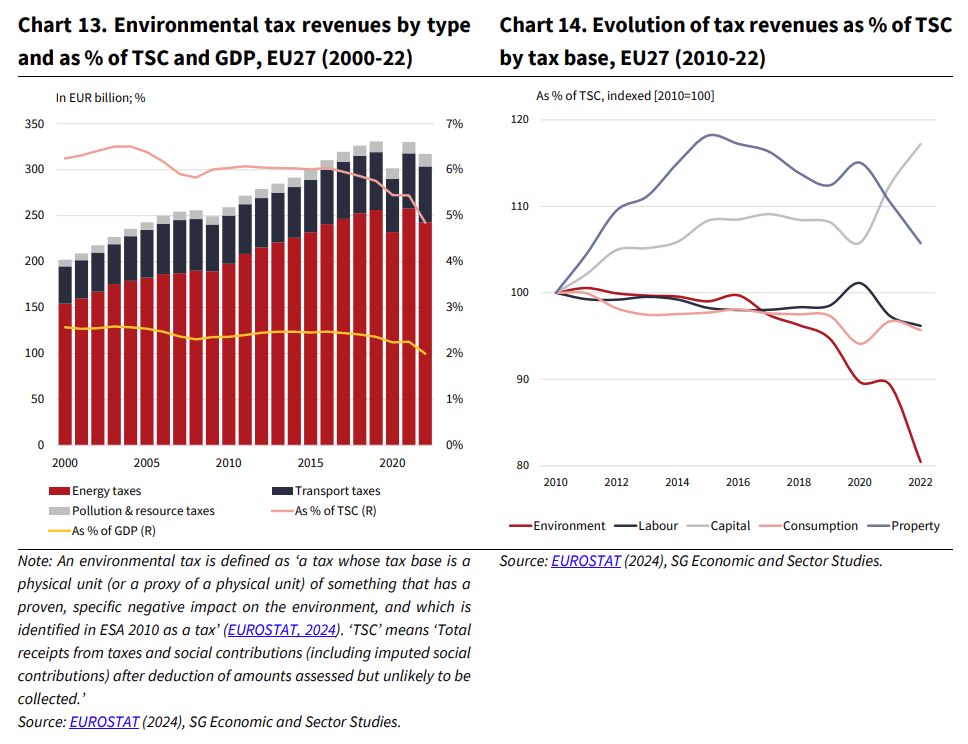
Taxes levied on energy (including carbon taxes and ETS's), transportation, resources, and pollution are all types of green taxes. Across the EU, direct carbon pricing accounts for around 12.5% of the total levied on negative externalities during 2022. Its a small but no less valued revenue stream for public budgets. Nevertheless, its important to keep it in context. Total EU wide government revenue stands at almost €8 trillion. Revenues from the auction of EUAs amount to a mere 0.5% of the total tax take.
Despite the popular narrative vis-à-vis net-zero etc., there is no evidence that European governments have shifted the taxation burden towards correcting environment ills. On the contrary, green taxes have declined in importance relative to other sources of tax revenue (consumption, labour, etc), and particularly so since 2015. As of 2022 this type of tax accounted for about 5% of total EU revenue (or 2% of GDP), a decline of 20% in their share since 2015.
There are two main problems with environmental taxes.
As the activity being taxed declines, revenue raised will naturally erode over time. The decline in the EU's environmental tax take since 2015 reflects the blocs shift away from fossil fuels. The move towards electric vehicles threatens to put a big dent in revenues from fuel duty for instance.
Governments faced with dwindling budgets either need to crank up the tax rate even further (although this has its limits, and can create nasty side-effects), or seek out alternative sources of tax revenue. To that end they are no different from other forms of sin taxes: the harder the government tightens the screws, the more rapidly behaviour changes, and the less revenue there is to capture (see The Carbon Laffer Curve).
Furthermore, environmental taxes are regressive in nature meaning that their burden tends to fall on those with the lowest-incomes. For example, poorer households tend to spend more on transportation and heating as a percentage of their income than those who are better off. It's one reason why ETS2 (covering transportation and buildings) has proven so controversial, and contributed to its launch being delayed by one year.
Despite its declining share of total EU tax take, environmental tax revenues have consistently exceeded expenditures on environmental protection over the past decade or more, typically by a factor of 150%. It highlights the EU’s reliance on environmental and energy tax revenues to support broader fiscal needs, and the limited levels of reinvestment into environmental protection.
It's not just about the amount of spending either, it's where its focused that matters too. For example, of the revenue raised by ETS1, only around 16% of allocated funds are recycled back into investment in covered sectors (energy and industry), while 44% is directed toward non-covered sectors (such as buildings and transport). Furthermore, 13% of revenues were directed toward "indirect carbon cost compensation" for energy-intensive industries (Refund policy: Industry compensation for indirect carbon costs must be conditional).
As Europe faces its second fossil-fuel energy crisis in less than five years, the pressure on the blocs governments to accelerate the transition to renewable energy and electrify the economy has intensified. However, dramatically cutting Europe's reliance on fossil fuels will require substantial capital, which will need to be supported by public investment. At the same time, governments face a quandary since the shift away from fossil energy sources will substantially erode environmental tax revenues (see Electric avenue: Europe set to outline its path to electrification and energy security).
Read the rest of this article with a 30-day free trial*
*and get access to the entire archive!