His father's son
Flávio Bolsonaro spells trouble for Brazil's climate policies

Welcome to Carbon Risk — helping investors navigate 'The Currency of Decarbonisation'! 🏭.
Carbon Risk contributes 1% of its revenue to Stripe Climate, helping to scale permanent carbon removal technologies. Thankyou to all the subscribers that support Carbon Risk.
If you enjoy this article please share it with someone and check out the Table of Contents for more insights.
For a limited time only (until 30th September), subscribers to Carbon Risk can gain full access for just $49.50 per year (normal price $99)
Climate and environmental policies work best when all participants believe they will remain strong and be there for the long-run. Chopping and changing between leaders, one pro-environment, the other pro-everything but the environment, weakens the incentive for change.
In October 2022, Luiz Inácio Lula da Silva was re-elected president. In the months that followed his government quickly enacted stronger environmental policies, applied to host the climate conference COP30, and beefed up enforcement efforts aimed at protecting Brazil's tropical rainforest.
The most vivid example of the improvement under President da Silva's leadership has been the decline in deforestation.
Non-fire related forest clearance has declined by 60% since 2022, dropping to the lowest level on record in 2025, according to the World Resources Institute's (WRI) Global Forest Watch initiative. In contrast, former President Jair Bolsonaro oversaw a systematic weakening in environmental protections, exemplified by a doubling in the rate of deforestation during his tenure (see Repricing deforestation risk in the wake of Brazil's presidential election).
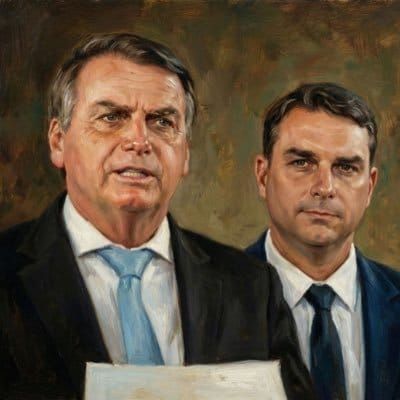
The forthcoming general election, scheduled to take place on 4th October 2026, may see Brazil change course once again, and in doing so, risks undoing the progress made under the leadership of President da Silva. With Jair Bolsonaro serving a 27 year sentence for plotting a military coup, the challenge this time will come from his son Flávio.
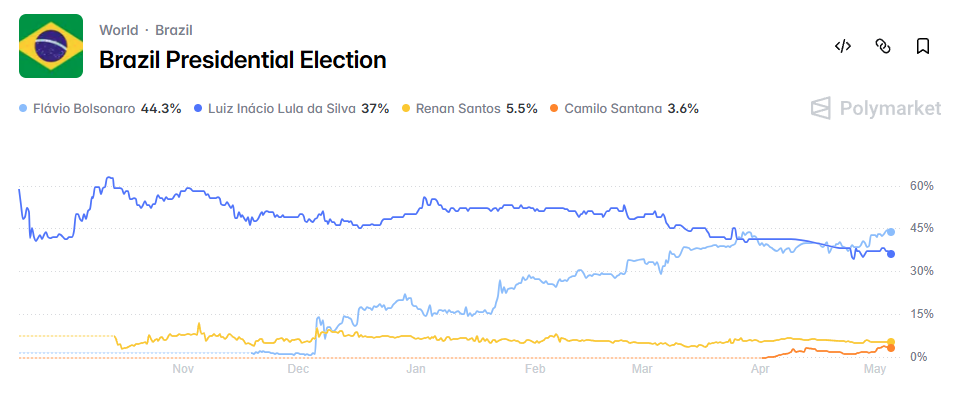
President da Silva and Flávio Bolsonaro are locked in a statistical tie according to the latest poll conducted by AtlasIntel for Bloomberg News. The younger Bolsonaro has closed a 12-point lead since he launched his campaign in December. He now has an implied 44% probability of winning the election according to Polymarket, compared to 37% for the incumbent da Silva.
Despite da Silva's progress, agriculture continues to be the most important driver of primary forest loss (73% between 2002-2025), largely to make way for soy and cattle. This could get much worse under the son of Jair Bolsonaro. In late April, Flávio promised to end the Amazon soy moratorium, the 20-year-old voluntary accord that bars traders from buying soybeans from lands deforested after 2008.
The incentive to knock down the forest is driven by the profit that can be gleaned from the materials that lie beneath, what can be grown or grazed on top, plus the value of the felled timber. High commodity prices, coupled with a weakening in the Brazilian real (a regular feature under Bolsonaro's rule), increases the political pressure to extend into the Amazon.
A change in political leadership threatens Brazil's forests, but it could also negatively affect many of Brazil's other signature climate policies. Key climate initiatives at risk of being paused, or worse cancelled, include the Brazilian emissions trading scheme and the Tropical Forest Forever Facility (TFFF); the latter a mechanism meant to pay countries to leave their trees standing.
In late 2024 Brazil's government approved a bill to regulate the country’s mandatory and voluntary carbon markets. Twelve months later policymakers released a roadmap detailing how the government expects the carbon price to reach $60 per tonne by 2050, helping to reduce emissions from covered sectors by 21% (see Brazil's carbon market gets the green light: Policy secures the nation's climate leadership among world's biggest oil producers).
Only around a quarter of the emissions produced in Brazil will be covered by the carbon market, primarily from the oil & gas sector, but also other carbon intensive industries such as cement, iron and steel, and aluminium. Brazil has little need to rely on carbon markets to price out fossil fuel power generation. Ample hydroelectric power generation, coupled with recent investments in solar and wind, has meant that Brazil is in a position to generate almost 90% of its electricity from renewables.
Critics of the carbon market proposals have accused the government of letting Brazil’s main source of emissions - land use change and agriculture - get off scot-free. However, it’s not unusual for forestry and agriculture to be outside the coverage of carbon markets. In Europe for example, farmers have long pushed back on agriculture’s inclusion based on the difficulty of monitoring emissions, while governments have been wary of food security concerns and the potential impact on food prices.
Even despite the political uncertainty, it was always unlikely to be fully operational this decade. Early estimates pointed towards an implementation phase lasting 5-6 years. The preparation and legal framework could take 1-2 years, pilot testing and initial rollout could take 1 year, and then the submission of monitoring plans and emissions reporting are likely to be completed within 1-2 years after pilot testing has been completed.
The Brazilian carbon market would have significantly expanded coverage in Latin America, a region where just 2% of emissions are currently covered by an ETS. Should Bolsonaro come to power in October, the impact on carbon pricing could stretch well beyond Brazil's borders. It is the founding member of the Open Coalition on Compliance Carbon Markets, a framework in which members would "advance possibilities of coordination on development and enhancement of compliance carbon markets". That too could now be under threat (see here and here).
While the emissions trading scheme was meant to put a price on industrial emissions, incentivising firms into decarbonising, the rationale behind the Tropical Forest Forever Facility (TFFF) is that by putting a monetary value on conservation you change the way people see stripping the land versus protecting it from exploitation.
The TFFF was formally launched in November 2025 at COP30. President da Silva stood in front of most of the worlds leaders, announcing that “For the first time in history, countries of the global south will take a leading role in a forest agenda.”
Brazil became the first country to back the initiative financially, with President da Silva announcing a $1 billion commitment. The funds ultimate goal is to raise $25 billion from government sponsors, from which it aimed to leverage $100 billion in institutional investment.
The capital raised by the fund would be invested in a mixture of emerging market bonds returns. The interest on the bonds would be returned to investors and used to pay countries that had increased or maintained their forest cover. Early on many spotted that the TFFF was based on a flawed premise: that the carry (the expected premium on emerging market bonds) is free money sitting around not being utilised.
The TFFF's proponents appear to have misunderstood that the carry reflects the markets pricing of sovereign default risk. If a single country defaulted on its debt obligations the whole structure could topple. While a good idea in principle, the design of the funding mechanism means that the TFFF is not quite the panacea many believe it to be.
By late April, the TFFF fund holds an estimated $6.7 billion, far short of the $10 billion end of 2026 target. Momentum has slowed significantly since launch with some countries (including the UK, an early backer of the TFFF), subsequently withdrawing pledges as fiscal pressures rise and overseas aid budgets shrink. Funding from Brazil, its most important backer, is also under threat should Bolsonaro be elected in October.
In that scenario the TFFF is likely to unravel completely. While the fund is flawed in many respects, it is still represented a fresh approach in how market mechanisms are used. Brazil and the world are so much the poorer if policymakers are now deterred from pushing through other innovative approaches to tackling deforestation.