Commitment issues
“It takes many good deeds to build a good reputation, and only one bad one to lose it.” - Benjamin Franklin
When a government begins to lose economic credibility, the market will punish it by selling government bonds, forcing up interest rates and washing itself of it’s currency.
As I’ve outlined in previous posts, I believe that one way of framing carbon markets is through the lens of a currency - ‘The Currency of Decarbonisation’.
If a government introduces a carbon price and commits itself to this policy for the foreseeable future, then obligated emitters, investors and other market participants will react by incorporating the expected carbon price into their investment decisions.
However, the market will judge the governments commitment as somewhere between zero and absolute. The greater the perception is that a government might not stick to its self-imposed commitment, the larger the discount the market will factor in to the carbon price.
A loss of climate policy credibility means that businesses will either postpone investing until the policy uncertainty is resolved, or they will demand higher rates of return. Either way, the total level of emissions abatement achieved is likely to be reduced.
Knowing the ‘commitment issues’ signs to watch out for is going to be more important over the next few years. Commitment perceptions will influence the future direction of compliance carbon markets such as the EU emissions trading scheme (ETS), voluntary demand for carbon credits from the corporate sector, and individual nation demand for carbon credits with which to meet their commitments under the Paris Agreement.
How strong carbon markets show commitment
Assuming that the government or institution responsible for carbon markets acts in its self-interest, the more the observable gains from compliance with the ETS outweigh the observable gains from reneging, the more credible a policy is. Reputation and commitment devices are central to determining the credibility of a government, or an institution responsible for climate policy.
A long history of policy support is a strong reputational indicator of commitment. As I outline above, this creates a virtuous circle whereby emission abatement is achieved at lower cost. Even better if the policy has been gradually tightened over time. That kind of political support is difficult to achieve, and even harder to achieve over a long period of time.
A commitment device is often used by the government or institution responsible for implementing policy to demonstrate commitment. By deliberately restricting the option to deviate from the policy, other stakeholders become more confident that it will not be revoked.
There are three distinct types of commitment device used in carbon markets: legislation, delegation and securitisation.
Enshrining it into law, even if subsequent administrations could realistically alter it, is the most important driver of credibility. Legally binding obligations force obligated emitters to respond. Also, by making carbon policy part of the legislative process means that it is open to public scrutiny. That makes it much more difficult for policymakers to quietly drop the policy.
There are numerous legal statutes that underpin the smooth running of emission trading schemes. One of the fundamental laws is that of legitimate expectations. A summary of the law and its implications is outlined in the 2014 book, Emissions Trading Design - A Critical Overview by Stefan E. Weishaar:
“The basis of this concept is that lies in good faith and requires that, once regulators have induced a business operator to act in a certain way, they should not alter their conduct so that the operator incurs losses.”
“A reversal of policy however does not violate legitimate expectations. Rather there is the presumption of a freedom to legislate because prudent traders should take into account the possibility of legal changes.”
In short, market participants would only have a legal case if the EU ETS was altered in some significant way, without a suitable transition period being put in place.
Even if it is enshrined in law, market participants know that subsequent governments may revoke or at best dilute the policy. Delegating at least some authority to an institution insulated from short term political whims, and with a timeline beyond the electoral cycle adds an extra layer of commitment.
The final element of a credible commitment device in carbon markets is securitisation. Securitisation entrenches the policy commitment by weaving it into private property rights and contracts. This is why carbon trading is so much more credible than carbon taxes. Adopting long dated allowances, i.e. permits that emitters can hold for many years to hedge future compliance adds an extra layer of commitment. Holders of allowances have an extra incentive to lobby for the carbon trading scheme to continue.
Putting commitment devices into action
The EU and California carbon trading schemes (two of the oldest emissions trading schemes), make use of all three commitment devices.
The legislative framework of the European carbon market is spelled out in the ETS Directive. Now into its fourth trading phase (2021-2030), the ETS framework has undergone several revisions to maintain the system’s alignment with the overarching EU climate policy objectives. For example, the EU's target of reducing net greenhouse gas emissions by at least 55% by 2030. The “Fit for 55” package aims to bring EU legislation in line with the 2030 goal.
The EU ETS is supported by a tripartite system of governance between the European Commission, Council (representing the member states) and Parliament. This means that no single EU country has the power to unilaterally change the carbon market based on short term political pursuits. Any proposed change has to go through many stages, and that takes time.
Meanwhile, in California, landmark legislation was passed in 2016 requiring the state to reduce its overall emissions to 1990 levels by 2020, and 40% below 1990 levels by 2030 while also appointing the California Air Resources Board (CARB) to develop policies to achieve this goal. CARB is the “clean air agency” of the state government. CARB implements and enforces the state’s cap and trade system. It works on the basis of successive 5 year plans that detail how the state will achieve it’s targets.
Finally, securitisation. Compliance entities and non-compliance entities (e.g. financials) are active in both the EU and Californian markets. A broader array of participants increases the political base from which opposition to water down the schemes could come from. Both markets enable entities to hold physical allowances for long periods in order to meet future compliance needs. Meanwhile, the development of carbon futures markets also embeds the carbon market into private contracts, making it much more difficult for governments to unpick.
When credibility is lost
The EU’s carbon market was not the worlds first cap-and-trade system to tackle a serious environmental problem. In response to the threat posed by “Acid Rain” the Clean Air Act Amendments of 1990 (CAAA) were signed into law, establishing a cap-and-trade system for SO2 pollution allowances.
In 2005, the Administration of George W. Bush enacted its Clean Air Interstate Rule (CAIR) with the purpose of lowering the cap on SO2 emissions to 70% below the 2003 emissions level. Aggressive cuts to the emission cap resulted in the price of allowances rising 4-fold from around $250 to over $1,000 per tonne.
However, the bull market was not to last. Prices collapsed after the EPA announced that it would re-examine CAIR and speculation about impending legal challenge to the EPA involving a number of states and utilities.
In short, the legislation had not been sufficiently developed for the long-term. A quick and dirty policy fix opened the whole market up to legal challenge. There was no commitment device in place and so trust in the market evaporated (see The great sulphur dioxide allowance bull market).
How credible are climate commitments made by nation states?
The commitments that countries have made under the Paris Agreement are known as Nationally Determined Contributions (NDCs). It’s important to remember that these commitments are entirely voluntary. The UN or some other body does not have the means to dish out any punishment should a country fail to meet its NDC.
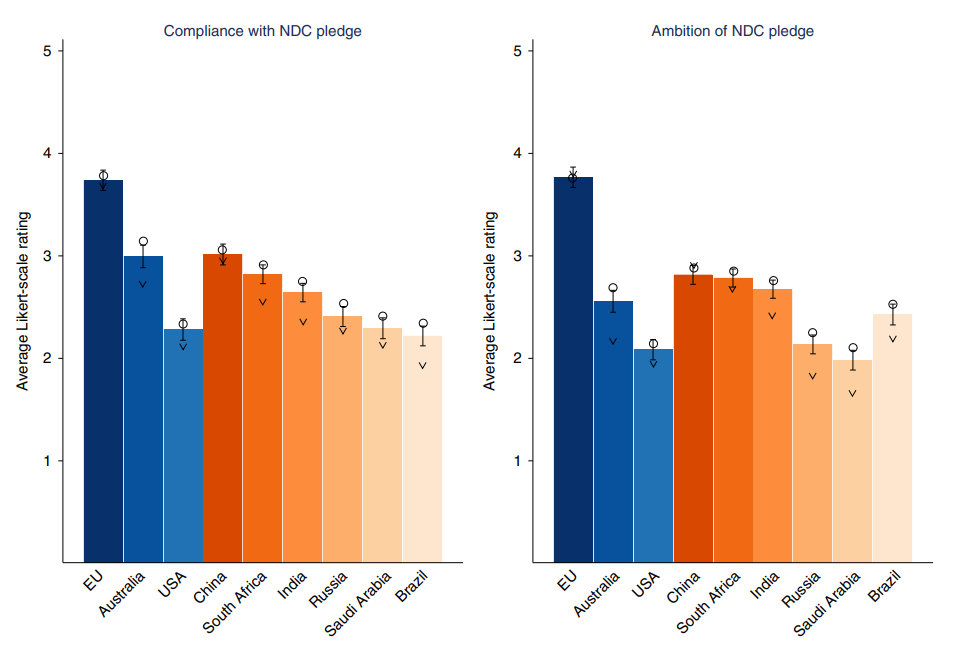
In the absence of consistent methodologies and viewed from the outside, it is very difficult to evaluate how current and successor national governments will put stated climate policies into effect. A recent study published in the journal Nature, attempted to determine the credibility of international climate commitments by exploiting “the wisdom of crowds”. Not just any crowds, but experienced climate policy and science experts. Each was asked several questions related to the ambition of individual countries climate pledges, and importantly, how likely they were to meet the commitments.
The responses revealed that those countries with the most ambitious climate commitments were also judged to have the most credible plan, and in turn were deemed more likely to achieve their NDC. In other words, the countries making the boldest commitments tend to be the most credible (see The first signs of carbon credit nationalism?).
The EU was seen as having by far the most credible commitment. The research suggests that, “the quality of national political institutions is the largest explanator of the variation in credibility, and Europe’s credibility is exceptionally high.”
China was second, followed closely behind by Australia. On the basis of this analysis at least, the United States was seen as being on a par with Saudi Arabia and Brazil.
Chart: Assessment of expected compliance and ambition of NDC pledge for non-home countries of climate experts
We’ve seen how legislation is a vital step in increasing the credibility of compliance carbon markets. The same commitment device is used by governments to help meet their Paris Agreement pledges.
For example, the UK Climate Change Act (CCA) of 2008 stipulates ‘legally binding’ interim and long-term (2050) targets for emission reductions. The duties and powers of government, parliament, and an independent advisory body are all defined by the governance structure.1
The UK was the first major economy in the world to pass laws to end its contribution to global warming by 2050. The target will require the UK to bring all greenhouse gas emissions to net zero by 2050, compared with the previous target of at least 80% reduction from 1990 levels.
The second commitment device underpinning the UK’s climate policy is delegation. The Committee on Climate Change is a government independent monitoring entity. It has the authority to advise and monitor the governments performance on a regular basis. The government have a legal obligation to regularly obtain and respond to the CCA’s advice.
Other countries have introduce similar legislation. These include Norway, Sweden, France, New Zealand and most recently, Australia. However, none appear to be as credible as the UK’s.2
Guilt by association?
Governments - ALL governments - should never take their reputation for granted. To assume that the electorate or the market will always be there for them, simply because they have supported them in the past, is folly.
Once governments lose trust in one arena of policy they can quickly lose it in another. Remember, it only takes one misstep to unwind all the good work achieved in building a good reputation.
Such a misstep has occurred in the UK in recent weeks following the appointment of new leader, Liz Truss. The UK’s so called ‘fiscal event’, (*cough*, massive Budget) turned into a big ‘market event’ in part because the government avoided the fiscal scrutiny of the Office of Budget Responsibility (OBR), the resulting turmoil heaping pressure on the Bank of England (BoE) to stabilise markets.
The OBR was setup and the BoE given independence to impart credibility on the UK’s public finances through their scrutiny and their distance from politicians. The mandate given to both institutions is an example of a strong commitment device.
However, once a government looks to circumvent those same institutions, meddle with its processes and impose it’s political will, investors may start to question whether other commitment devices are as sound as they first appear.
If the market sense commitment issues extend to climate policy too then the cost of meeting targets will get even more expensive, and the chances of hitting them less likely.
The UK CCA introduced a carbon budgeting system in which every single budget covers a period of five years and at least three budgets must be set in advance. ↩
Indeed, one of the first moves by the new Australian government was to increase the country’s 2030 emissions reduction target under the Paris Agreement to 43% below 2005 levels, up from 26–28% previously. That target is now enshrined in a new Climate Change Bill that was passed in September. ↩