Return of the MACC


The marginal abatement cost (MAC) curve has been an important tool for climate tech investors, carbon market traders, and policymakers.
Sloping upwards from left to right, the MAC curve gradually steepens as additional tonnes of emissions get increasingly more difficult, and hence more costly, to abate. The marginal abatement cost, the cost of abating the last tonne of emissions required to meet a target, is one way that we can get a fix on how high the carbon price needs to be.
The original MAC curve dates back to 2007 when the consultancy McKinsey & Co first released the graphic below illustrating the most economically rational technical abatement opportunities to reduce global emissions by 2030. Their focus was on abatement measures with a societal cost estimated to be less than €60 per tonne CO2, equivalent to around €95 per tonne CO2 in todays money.
McKinsey claimed that if all of the opportunities were exploited to their full potential - "clearly an optimistic assumption" they add - global GHG emissions in 2030 could be 70% below a business-as-usual scenario. If these measures were pursued aggressively they say, it should be "sufficient to have a good chance of holding global warming below the 2 degrees Celsius threshold."
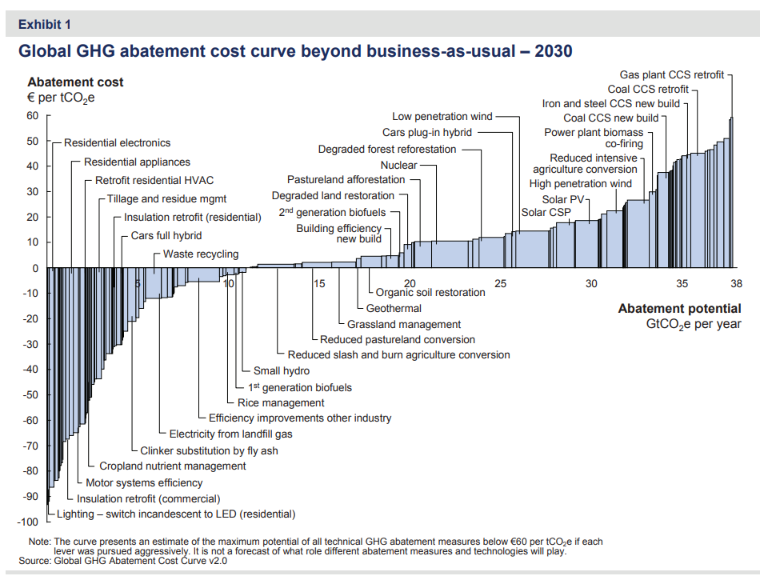
The "McKinsey curve" as it came to be known as, quickly became the framework through which policymakers could focus their attention on the least cost emission abatement opportunities, but also which technologies were likely to need nurturing and investing in if they were ever to come down in cost.
Alas, almost two decades on and only a few years shy of 2030, it's clear that global GHG emissions are only now getting to the point where they might have plateaued. Keeping the global temperature increase to no more than 2 degrees Celsius (3.6 Fahrenheit) above pre-industrial levels still appears a distant prospect (see Readying for the descent: Proposed reforms to China's emissions trading system suggest the government is preparing for peak emissions).
Is the MAC curve really all its cracked up to be, or has it led governments down the wrong path, pursuing least cost abatement opportunities as they find them, rather than considering the whole system costs? The implications are important for investors and governments in the West, but they also have implications for emerging economies who are now in a position to consider the sequencing in which abatement technologies are introduced, and not repeat the same mistakes.
Read the rest of this article with a 30-day free trial*
*and get access to the entire archive!