#EUAPredict 2026
What's your forecast for the EU carbon price in 2026?

It's competition time!
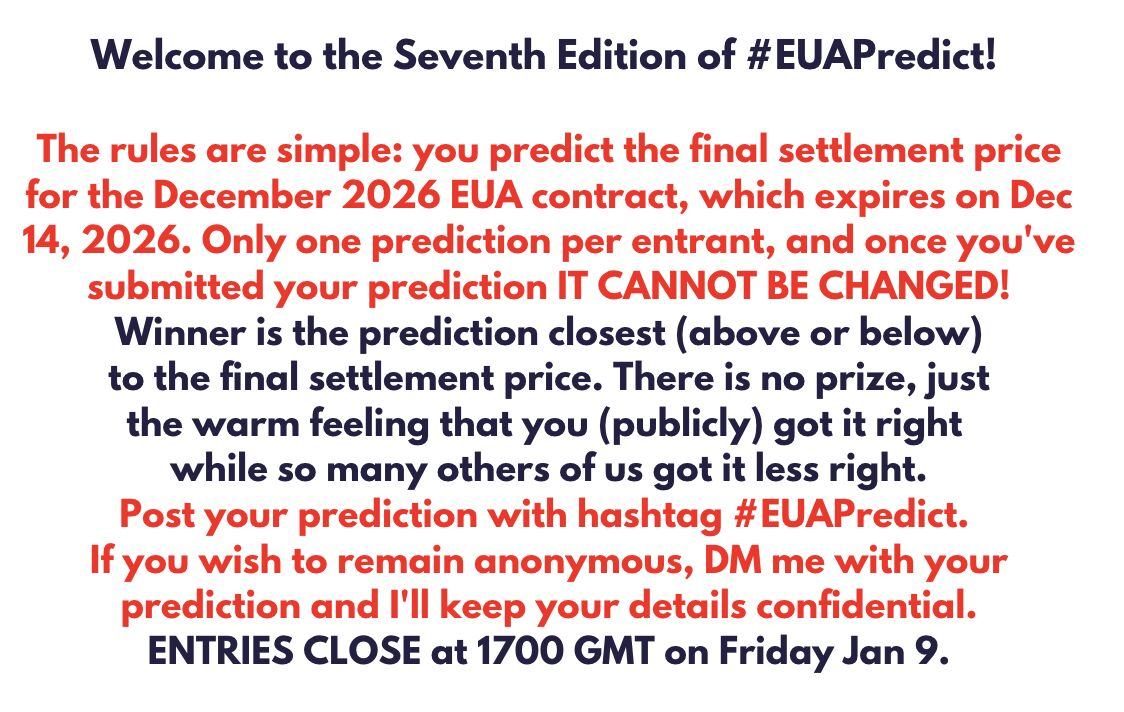
Alessandro Vitelli (aka 'The Carbon Reporter') has just launched the seventh edition of his #EUAPredict competition. Before we hear why Alessandro started the forecasting competition and why you should enter #EUAPredict this year, here's a quick run down of the rules.
Alessandro first launched #EUAPredict in 2020 as a way of building community. The EU carbon price had started to rise quickly and a forecasting competition was a neat way of engaging people who were only just getting into the market. However, it wasn't long before Alessandro realised that the competition had other uses as well:
"I quickly understood though that #EUAPredict is also a great way to measure the collective sentiment of the market: the analysts get to have their say, but traders and other stakeholders also have a view and that hasn’t often been taken into account in a similar way."
So, how has #EUAPredict performed?
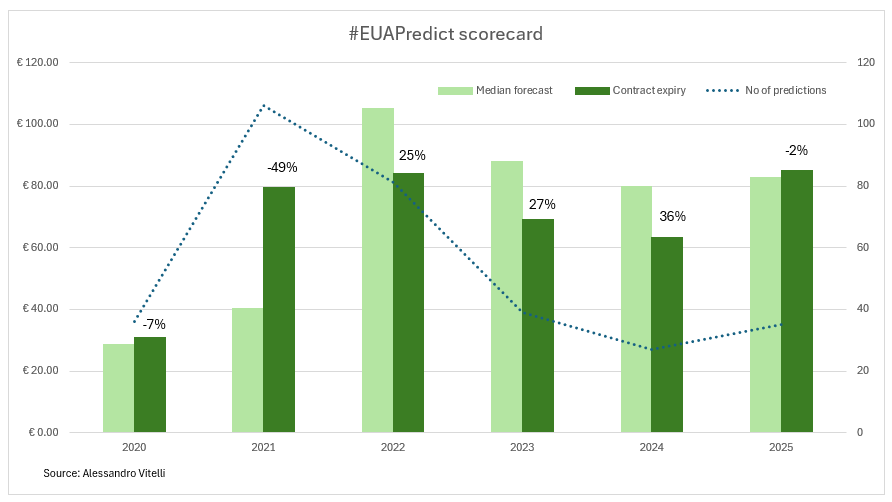
The mean absolute percentage error across the six competitions (based on the median forecast from respondents) is 23%. The error rate hit a high in 2021 with the end of year carbon price almost double the median forecast. More than 100 people entered the competition that year as expectations of high prices drew in a large crowd. Last year the crowd was especially wise with the median falling just 2% short of the December 2025 contract expiry price.
It's worth noting that data stretching back to 2010 tells us that 23% is actually rather good and compares well to professional carbon analysts. In 2022 DWS published a piece of research comparing analyst forecasts made at the start of each calendar year between 2010 and 2021 with the outturn at end of the year. They found that the carbon analysts price predictions typically have an average absolute error rate of 35.5%.
Although the likelihood that #EUAPredict will have another banner forecasting year is very slim, there are ways that we can improve our chances. The wisdom of crowds suggests that the collective intelligence of a large group makes superior judgements than any single expert. Hence one motivation for me writing this post is to encourage more people to enter #EUAPredict.
However, more respondents doesn't necessarily equate to improved forecasting precision, in fact, as Friedrich Nietzsche warns, "insanity is rare [in individuals]; but in groups, parties, nations, and epochs it is the rule". According to Michael Mauboussin, investment strategist at Morgan Stanley, we are more likely to harness the wisdom (rather than the madness) of crowds if three conditions are in place:
- Heterogeneity (or less formally, diversity) such that respondents have different points of view, see things from a range of perspectives, and base their forecasts on different information sources and rules.
- An appropriate aggregation mechanism; markets tend be best except when the herd takes over. Competitions work well (think of guessing the number of sweets in jar, or the weight of a cow) when you are not swayed by other peoples answers.
- Incentives (i.e. rewards for being right and / or penalties for being wrong) ensure that respondents are motivated to put their thinking caps on.
If you think you have something to add you can enter #EUAPredict by posting your end of year EUA prediction on LinkedIn with the hashtag #EUAPredict, or ideally (given the three conditions outlined above) DM Alessandro on LinkedIn with your prediction, or send him an email on alessandro@carbonreporter.com. Remember, entries close at 1700 GMT on Friday 9th January - only three days to go.
Good luck!
ps. Be sure to check back in a week or so to see how your prediction compares with other people and what the median forecast tells us about EU carbon prices in 2026.