The Polluter Pays (in) Principle
Or, one rule for me, another for thee

Welcome to Carbon Risk — helping investors navigate 'The Currency of Decarbonisation'! 🏭.
"In the European Union, if you pollute, you have to pay a price for that. If you want to avoid paying that price, you innovate and invest in clean technologies." - European Commission President, Ursula von der Leyen
The Polluter Pays Principle (PPP) says that those who pollute should bear the cost of managing the negative externality, the damage they have caused to the environment and to human health. By incorporating this cost, carbon pricing acts as a signal, incentivising producers to switch to cleaner, less carbon intensive manufacturing methods, and for individuals to cut back or move to more sustainable alternatives.
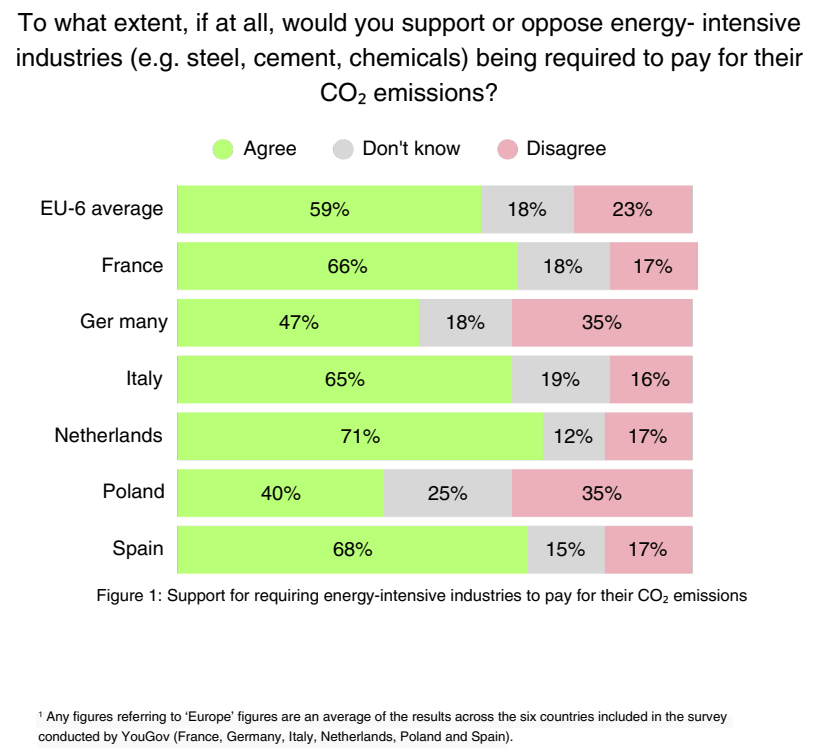
Ahead of the publication of the European Commission's review of the EU ETS (now scheduled to be published on Friday 17th July, two days later than planned), a survey conducted by YouGov on behalf of Beyond Fossil Fuels, examined EU citizens attitudes to carbon pricing. YouGov surveyed 6,156 people during the period 6th-18th May across six countries: France, Germany, Spain, Italy, Poland and the Netherlands.
It found that 59% of EU citizens (the average of the 6 countries surveyed) want energy intensive industries to pay for their carbon emissions. Furthermore, 72% believe that the highest emitters, and the "climate laggards" that have failed to reduce their emissions, should face a higher carbon price than other less carbon intensive companies. Across the sample of six countries, Dutch citizens came out most strongly in support (71% and 84% respectively).
Not everyone wants polluters to pay. Almost one-quarter (23%) of EU citizens polled disagreed that with the idea that heavy industries should pay a price for their CO2 emissions. Respondent in Poland and Germany were least supportive with one-third (35%) opposed.
Importantly, carbon pricing finds support across political and ideological lines. Even amongst those that would naturally be opposed to carbon pricing (i.e., supporters of far-right parties), between one-third and a half of respondents are in favour.
While the results are encouraging the survey doesn't explain why people responded the way they do, nor and perhaps crucially, it isn't entirely clear that people understand the question posed, nor the implications of heavy industries paying a carbon price commensurate with the damage their pollution causes.
It seems reasonable that people think that whoever pollutes should pay a price inline with the damage they have caused. But people may not appreciate that the EU carbon price is set by the market, in theory at least at a level consistent with meeting the declining cap on emissions - what's known as the marginal abatement cost of carbon. However, if the carbon price is going to atone for the damage caused then it will need to be much higher, reflecting the social cost of carbon (see Everything you need to know about the Social Cost of Carbon (SCC)).
Perhaps they also instinctively feel that its unfair that heavy emitters and "climate laggards" are free-riding on the actions of those companies that have already invested in cutting their emissions. It's only reasonable that companies with the foresight to invest shouldn't be penalised simply for being the ahead of the game.
The bigger question I believe is whether people have thought through the short-term implications of a carbon price. Do people understand that the PPP ultimately means that it is they who will be the ones footing most (or even all) of the bill through higher prices?
Companies typically pass on as much of the carbon price onto their customers as possible. The main factors determining the degree to which cost-pass-through takes place includes fixed costs as a share of the overall cost base, the price elasticity of demand, and the level of competition in the market.
An empirical review by ABN AMRO put EU ETS industrial cost-pass-through at 66%. By comparison, aviation and electricity generation are estimated to be much lower (24% and 42%, respectively), while for fossil fuels and shipping, 100% of the cost is assumed to be passed on to the consumer.
Public awareness and understanding of carbon pricing is crucial if it is to be effective, while also being robust against attack. Right now everyone is focused on ETS1, but very soon, it will be its sequel, ETS2 that will capture the limelight.
Europe's second carbon market is designed to put a price on transportation and heating fuels. If the cost-pass-through estimates are broadly correct then nigh on all of the carbon price will be passed onto the end consumer, the commuter trying to get to work, and the family attempting to warm their home.
ETS2 was supposed to launch in 2027, but after a debate last autumn it was delayed by one year, and is now scheduled to come into force in 2028 (see Softening the blow). But as Paul Mottram, founder of the Carbon Costs Coalition warns in a recent article for Reuters, public awareness and understanding is dangerously low:
"If the EU doesn’t communicate early and clearly – especially on how it will affect costs and how the revenue it generates will be used – it risks backlash that could derail not only the rest of Europe’s Green Deal but also the prospects for progressive and pragmatic climate policies worldwide."
While there is a way out for industrial emitters wishing to avoid paying a price on pollution - namely, innovating and investing in clean technologies - the same cannot be said for individual households. This is especially true since ETS2 will fall most heavily on those least able to switch to cleaner technologies, the lower-income households that spend a disproportionate amount of their income on transportation and heating.
As I wrote in Europe must learn from Canada's 'price on pollution' debacle back in January 2024, "Finding the carbon price sweet spot, a level that balances affordability for consumers with the need to advance climate action is essential if ETS2 is, like ETS1 before it, going to become a cornerstone of Europe’s climate policy."
Opposition to ETS2 suggests that when it comes to the PPP, its one rule for me, another for thee. Crucially though, unlike polluting companies that are able to pass on most if not all of the cost, individuals with limited access to capital (to buy an EV or install heat pumps), have little they can do to mitigate their exposure, short of asking their employer for higher wages.
This is especially important at a time of high energy prices. Prior to the energy crisis, the majority of studies indicated that green spending (i.e. revenues earmarked for climate-friendly projects) was the only complementary policy associated with a statistically significant increase in public support. However, ever since the Russian invasion of Ukraine, and the subsequent 'energy crisis', attitudes have (unsurprisingly) shifted.
A recent paper examined public attitudes to carbon pricing and revenue use in Germany between 2019 and 2022. In the middle of this period, the German government introduced a carbon price on transport and heating fuels (a prelude to ETS2). Beginning at €25 per tonne CO2 in 2021, the carbon price increased to €30 per tonne CO2 in 2022.
The research shows that while support for carbon pricing in Germany is persistently high (at ~60%), attitudes to how the revenues are spent has switched sharply in favour of "social cushioning", while support for green spending has declined. It's clear that those most affected by high energy prices are least in favour of carbon prices. Indeed, this cohort have a 20 percentage point lower probability of supporting carbon pricing.
It's crucial then, as the paper concludes, that from a policy-making perspective, governments must generate support for carbon pricing before it is launched, as it then has a greater likelihood of continuing afterwards. Policymakers must be flexible, tailoring how revenues are spent to reflect citizens needs and perception of injustices (whether real or perceived), something that is especially important at a time of high energy prices.
Read this article and more with a 30-day free trial
 Peter Sainsbury