No company is a net zero island


Welcome to Carbon Risk — helping investors navigate 'The Currency of Decarbonisation'! 🏭.
"A decade after the 2015 Paris Agreement articulated the “stretch goal” of limiting global temperature rise to 1.5°C above preindustrial levels, it has become clear that achieving this goal is no longer plausible." - Resources for the Future, Global Energy Outlook 2026
Last week the independent research institution Resources for the Future (RFF) published its annual Global Energy Outlook. The report brings together a range of long-term energy projections from eight organisations, including the IEA, BNEF, BP, ExxonMobil and Equinor. Harmonising 15 projections to "produce as close to apples-to-apples estimates as possible", the report identifies key trends in global energy consumption, emissions (see chart below), and geopolitics.
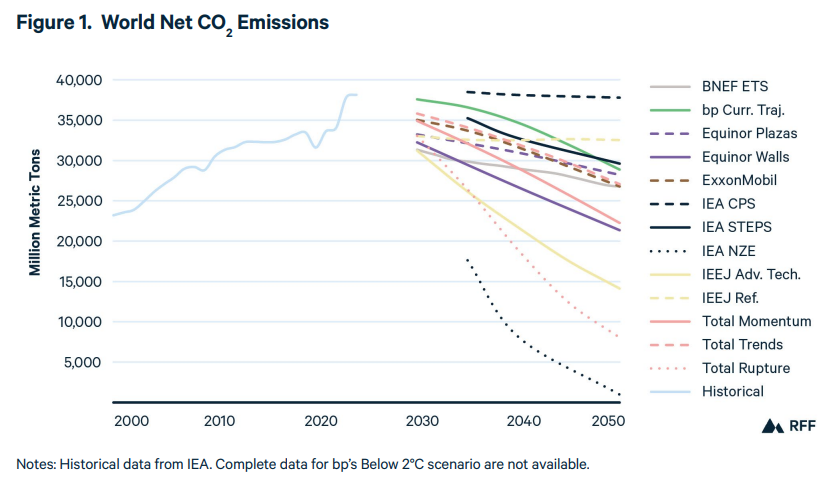
It's central conclusion is that while "preventing the worst impacts of climate change remains an essential global task, 1.5°C or net zero by 2050 scenarios now offer little practical guidance." The report begins by stating that the events of 2025 (and in particular, the bellicose rhetoric and subversive actions of the Trump administration) have shaken the global order, calling into question the key pillars of international economic and security systems, and especially those underpinning collective climate action. RFF note that governments have increasingly focused on energy security, affordability, and the cost of living, "relegating climate change to a second-tier priority (or lower) in many cases."
The same conclusion has prompted some of the worlds largest energy companies to argue that they will not be able to meet their previously stated net zero commitments. TotalEnergies and Shell recently stated that, while they will take action on what is under their control, they must, as Patrick Pouyanne, CEO of TotalEnergies pointed out in his companies sustainability report, "confront our ambition with reality,” and acknowledge that the energy transition is not proceeding at the pace required (see Caution! Net zero scenarios are not forecasts: Why the blurring of the normative and the predictive is leading to a misallocation of capital).
Pouyanne indicated that the pathways to his company achieving carbon neutrality must be "reassessed and adapted over time in line with the evolution of the global energy system", pointing to developments in "technical innovation, public policies and consumer choices." Shell CEO Wael Sawan was more pointed in his responses, laying the blame at governments for weakening climate policies, "Our objective has been to be a net zero business in a net zero world," he stated at International Energy Week 2026 in April, and "Were there a huge focus and ambition in enabling policies, then I think it [net zero by 2050] is absolutely possible,"
Indeed, its worth taking a step back and reflecting for a second. Its clear that the philosophy underpinning corporate climate commitments underplays the degree to which corporate emissions are embedded in wider societal systems. As the two energy majors allude to, public policy, transmission grids, transport infrastructure, and national regulatory frameworks all play a part in determining the speed at which companies can decarbonise, whatever their primary business activity.
While energy companies play a major role in the underlying architecture of the global energy system, they will only respond to the incentives presented in front of them. It's a quandary facing all companies that have publicly stated their commitment to net zero: how to continue pursuing a target that many argue is now very unlikely to be met. This article argues that no company is a net zero island, but there may be a more constructive way forward than the status quo.
As of September 2025 almost two-thirds (63%) of the Forbes Global 2000 (the top 2000 largest publicly traded companies) have net zero targets, according to Net Zero Tracker, covering $36.6 trillion in revenue (70% of total). While net zero targets signal corporate support, they are not, on their own, a reliable proxy for climate ambition.
A recent study scored the corporate net zero strategies of 3,500 companies against seven indicators of greenwashing, using data from Net Zero Tracker, CDP and InfluenceMap. The most problematic issue uncovered by the research was that 70% of companies excluded Scope 3 emissions from their net zero targets, this despite it typically constituting the largest fraction of corporate carbon footprints (see Owning up to Scope 3: How investors should think about the SEC's proposed disclosure requirements).
Perhaps the most important red flags related to the implementation roadmap, specifically, questionable use of carbon credits (40%), missing interim targets (21%) and a lack of meaningful progress toward targets (20%). Of the Forbes Global 2000 companies that set net zero targets, 31% failed to set concrete implementation roadmaps, undermining the credibility of those commitments.
Although roadmaps coupled with interim milestones (such as a 2030 emission reduction target) add credibility in the eyes of a companies stakeholders, time is marching on, and with companies some way off where they need to be in 3-4 years time, it won't be long before they start having to field some very difficult questions. So what's the best strategy given the strong headwinds facing corporate action on climate change?
Well, instead of obfuscating the issue, diverting attention away from their net zero targets, and the limited progress made towards meeting them, management need to become more open and honest about their spheres of influence. The energy companies, TotalEnergies and Shell, get it. It's time for other industries to adopt the same tone, and realise that reaching net zero will only ever be achieved by explicitly identifying what emissions they have agency over, and that which they do not, the two requiring very different strategies.
A recent white paper, a collaboration between Futerra and Oxford Net Zero, is explicit about this challenge, introducing its Spheres of Influence Framework. The narrowest of the three key spheres identified is the core products and services a company brings to markets. The second leverages a company's ability to direct financial flows to "accelerate the broader transition". The third involves shaping the external environment, influencing policymaking and educating the broader public. Its only by scaling the "Spheres of Influence", the authors of the paper argue, can we hope to counter the net zero backsliding vicious circle, and finally regain some momentum.
But maybe there is a more concrete way of thinking about this. Perhaps net zero targets need to be explicitly structured in a way that recognises the line between what emissions are within a firms agency, and those emissions that are not, but that require more system-wide change.
A recent paper Milkywire, a climate impact firm, introduces a new framework by which firms can clarify "responsibility, action, and claims under corporate net zero." Specifically, it says that net zero targets should be understood as two distinct commitments: the first targeting those emissions within a company's control, and the second, a separate conditional target that depends on broader system transformations.
Earlier I mentioned that 70% of the Forbes Global 2000 companies that had set a net zero target excluded Scope 3 emissions. The research identified that this was a major red flag, potentially signalling that a company's net zero commitment was not to be trusted. Not every company has the same ability to shape its Scope 3 emissions; a large vertically integrated company will have a lot more influence than an individual company in a long, extended supply chain.
Perhaps the problem is that companies and investors suffered from unrealistic Scope 3 expectations, and were unable to develop relevant strategies that aligned with their overall net zero target. A change in approach, along the lines advocated by Futerra, Oxford Net Zero, and Milywire based on spheres of influence and conditional emissions targets, could help turn things around.
It's now very unlikely that the world will meet net zero by 2050. An achievement that would have given the world its best chance of limiting the rise in global temperatures to 1.5°C. Corporate net zero commitments were designed for a world where international cooperation between likeminded entities was the default assumption. That world seems increasingly far off in the rear view mirror.
Corporations are right to commit to climate action, but a change in approach is needed, one that recognises what one can and cannot control. It's one that requires incentives to pursue every sphere of influence, both operational and broader systemic issues.
No company is a net zero island.